Compliance & Regulatory
PEGI 2026 Compliance Guide: New Risk Ratings for Loot Boxes, NFTs, and Online Communication
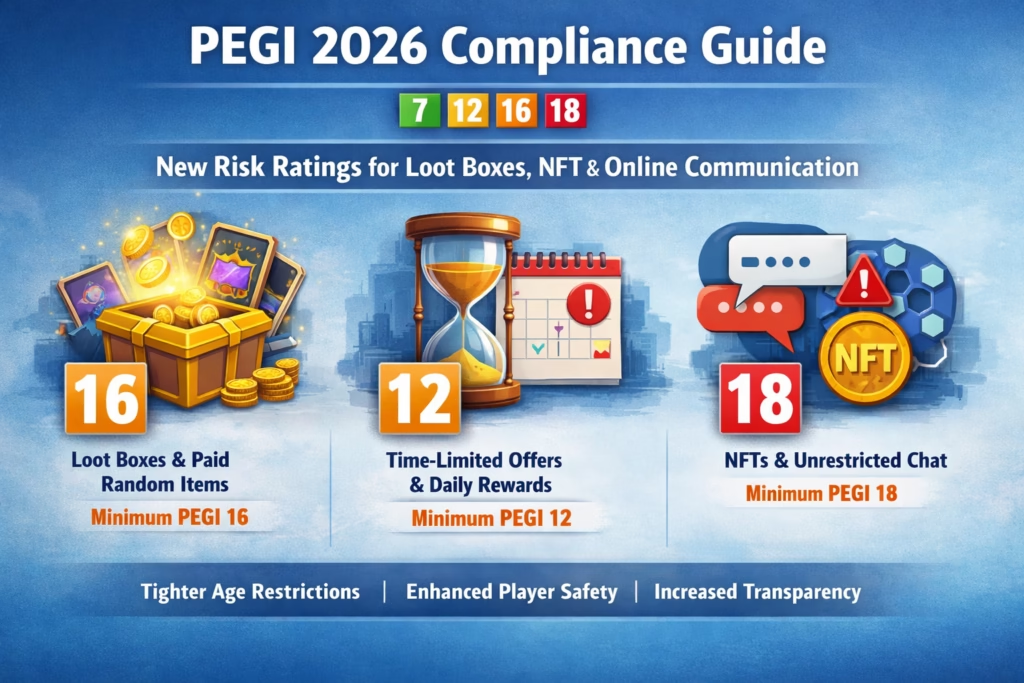

On March 12, 2026, the Pan-European Game Information (PEGI) system released an announcement that it will update its video game age-rating framework. PEGI classifies video games by age appropriateness across Europe (with the exception of Germany, which utilises the USK system).1 In the UK, PEGI took over the legal responsibility for game ratings from the British Board of Film Classification in 2012.2 The changes will apply starting in June 2026.3
From Content to Function: The 2026 PEGI Classification Framework
The updates will include adding new criteria that are meant to address monetisation models and urgency-based sales tactics aimed at younger users.4 The new criteria will be based on game features, classifying each one into a minimum PEGI rating. These certain game features will automatically reclassify games into higher age categories.5
The specific list is as follows: Games featuring loot boxes or paid random items like card packs will now have a minimum PEGI 16 rating. Games featuring time- or quantity-limited offers, or mechanics that penalise missed logins, will have minimum PEGI 12 ratings, due to their ‘pressure to play’ effects.6 Games with reward-based login systems were classified with a minimum rating of PEGI 7. Games featuring either the use of NFTs/blockchains or unrestricted online communications (for example without blocking tools) will face the highest classification criteria with a minimum rating of PEGI 18.
In this update, PEGI collaborated with the German age-rating authority, the USK, who made similar rating changes in 2023, updating the German Youth Protection Act.7 Following their own updates, the USK reported that approximately 30% of submitted games used the new criteria, and around one third of those received a higher age rating as a result.8 Referring to this collaboration, PEGI director Dirk Bosmans commented: “It was incredibly useful to learn from the experiences of our colleagues in Germany”.9
Although the updates have not yet taken effect, game publishers were advised that they may submit games to the system to be examined prior to their release and that they will soon be required to share if the new regulated features exist in the titles they wish to publish.10 In their announcement, the company stated: “Games can be submitted to PEGI for examination in advance of their announcement and their release, therefore PEGI expects that the first games classified under these new criteria will be announced later in summer of this year”. 11This means that games that are announced this summer will most likely be considered under the new rating classifications.12
The reason cited for the update is an effort to “bolster online safety and meet the concerns and questions of today’s parents”.13 PEGI director stated that: “We are confident that these ambitious updates to PEGI’s classification criteria will provide parents and players with more useful and transparent advice that better reflects the overall experience that players can expect from the video games they play”.14 Jeroen Jansz, chair of the PEGI Experts Group added that the company will continue monitoring the implementation of the new criteria over the next year.15
Market Impact and the Global Shift Toward Gaming Regulation
These updates are quite revolutionary for the gaming industry, and will come as tough news for some game publishers. Some upcoming titles could potentially see significantly higher age ratings than the developers potentially anticipated.16 For example, EA Sports FC will lose its traditional PEGI 3 rating and will now see a significant change, as it will be inadvisable for players under 16, as it features paid random items, namely Ultimate Team card packs in the FC series.17
The author believes these updates are very welcome, and seem to be part of a global trend in the games industry attempting to impose more stringent requirements on developers for the protection of users and children in particular. In the UK, Ofcom and the ICO introduced new age assurance requirements for tech and gaming companies, effectively ending the ineffective ‘self declaration’ method we have seen so far. In New York, Attorney General Letitia James sued Valve for promoting illegal gambling and threatening to addict children through its use of “loot boxes”.18 In Australia, the Communications Minister Anika Wells has raised concerns regarding claims of child exploitation on Roblox.
Law firm Reed Smith also notes that the risk rating updates come at a time of significant regulatory development for games companies across the UK, EU, and US.19 In the UK, the Online Safety Act, requires things like accessible reporting and complaints procedures, and allowing children under 18 to block or mute accounts, disable comments, etc.20 In that sense, Reed Smith notes that PEGI’s new communication feature category and the OSA’s requirements are mutually reinforcing.21
In the EU, the Digital Services Act also contains reporting and complaints obligations, but does not contain explicit blocking and muting obligations.22 Moreover, in October 2025 the European Parliament’s IMCO Committee voted to call for the Digital Fairness Act to ban gambling-like mechanisms such as loot boxes in games accessible to minors.23 Reed Smith comments that “PEGI’s reforms may in part reflect an effort to demonstrate that industry self-regulation can deliver meaningful results ahead of binding legislation”.24
In the US, Reed Smith raises the question of whether, following the New York Valve lawsuit, the ESRB, PEGI’s US counterpart, will consider comparable reforms to PEGI’s.25
Takeaways
As the overhaul approaches, game developers bound by PEGI will have to pivot strategically. Two main steps will have to be taken, as set out by Reed Smith’s analysis of the updates. Firstly, companies should review their monetisation and retention mechanics based on the new ratings, and assess the commercial impact of a potential rating increase.26 Secondly, communication features should be examined. If a game is accessible to minors, it should include blocking, muting, and reporting options.27
Ultimately, the author believes these risk rating updates are a necessary and possibly even over-due development. The new framework achieves, to a good extent, the goal set out by PEGI, increasing the level of transparency for parents and achieving a higher standard of accountability for game publishers. While it is arguable that the transition may pose commercial hurdles for some publishers, as some practitioners argued with the new ICO and Ofcom age assurance requirements, the prioritisation of user safety is crucial.
- Instant Gaming, ‘PEGI is about to expand its classification criteria to include in-game purchases and online gaming’ (17 March 2026) https://news.instant-gaming.com/en/articles/18495-pegi-is-about-to-expand-its-classification-criteria-to-include-in-game-purchases-and-online-gaming accessed 26 March 2026.
↩︎ - Marie Dealessandri, ‘Games with loot boxes will be rated PEGI 16 from June as part of sweeping changes to the age rating system’ (GamesIndustry.biz, 17 March 2026) https://www.gamesindustry.biz/games-with-loot-boxes-will-be-rated-pegi-16-from-june-as-part-of-sweeping-changes-to-the-age-rating-system accessed 27 March 2026.
↩︎ - Instant Gaming, (n 1).
↩︎ - Alan Friel, Niloufar Massachi and Christopher JS Topp, ‘PEGI Updates EU Video Game Age Rating System to Address Loot Boxes and Online Safety’ (National Law Review, 26 March 2026) https://natlawreview.com/article/pegi-updates-eu-video-game-age-rating-system accessed 26 March 2026.
↩︎ - Aaron Astle, ‘PEGI expands age ratings to cover loot boxes and in-game spending’ (PocketGamer.biz, 17 March 2026) https://www.pocketgamer.biz/pegi-expands-age-ratings-to-cover-loot-boxes-and-in-game-spending/ accessed 26 March 2026.
↩︎ - Marie Dealessandri, (n 2).
↩︎ - Alan Friel, Niloufar Massachi and Christopher JS Topp, (n 4).
↩︎ - Aaron Astle, (n 5).
↩︎ - Ibid.
↩︎ - Alan Friel, Niloufar Massachi and Christopher JS Topp, (n 4).
↩︎ - Bryant Francis, ‘PEGI revises its age ratings system with considerations for loot boxes, daily quests’ (Game Developer, 17 March 2026) https://www.gamedeveloper.com/business/pegi-revises-its-age-ratings-system-with-considerations-for-loot-boxes-daily-quests accessed 27 March 2026.
↩︎ - ibid.
↩︎ - Alan Friel, Niloufar Massachi and Christopher JS Topp, (n 4).
↩︎ - Aaron Astle, (n 5).
↩︎ - Vignesh Raghu, ‘PEGI expands age rating rules for online game features’ (Respawn, 18 March 2026) https://respawn.outlookindia.com/gaming/gaming-news/pegi-expands-age-rating-rules-for-online-game-features accessed 27 March 2026.
↩︎ - Marie Dealessandri, (n 2).
↩︎ - Instant Gaming, (n 1).
↩︎ - Jonathan Stempel and Bill Berkrot, ‘New York sues video game developer Valve, says its “loot boxes” are gambling’ (Reuters, 25 February 2026) https://www.reuters.com/legal/government/new-york-sues-video-game-developer-valve-says-its-loot-boxes-are-gambling-2026-02-25/ accessed 26 March 2026.
↩︎ - Nick Breen, Elle Todd and Harry Clark, ‘PEGI launches interactive risk categories, overhauls age ratings for loot boxes, in-game spending, and communication features’ (Reed Smith, 20 March 2026) https://www.reedsmith.com/articles/pegi-launches-interactive-risk-categories-overhauls-age-ratings-for-loot-boxes-in-game-spending-and-communication-features/ accessed 27 March 2026.
↩︎ - ibid.
↩︎ - ibid.
↩︎ - ibid.
↩︎ - ibid.
↩︎ - ibid.
↩︎ - ibid.
↩︎ - ibid.
↩︎ - ibid.
↩︎