General
From Track to Tournament: How Horse Racing’s Regulatory Model Could Inform the Future Legal Structure of Esports
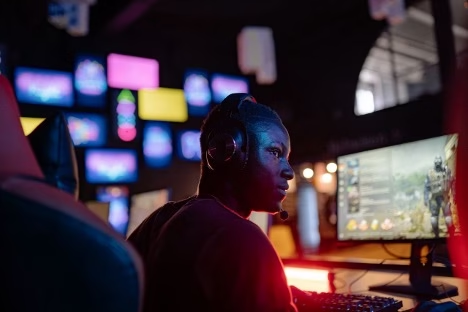

Honestly, horse racing and esports cannot be more different. One has centuries of tradition, racetracks, jockeys, and strict rules, and the other is a Gen Z-onward sport that is changing the way people engage with sports.
Very different words. But legally and structurally, the comparison is more useful than it seems.
Since esports is a new thing, it still has to develop into a real sport. This means going through legal issues and creating a proper structure. This process cannot be expedited. It takes time for things to settle and to create a norm.
Horse racing has spent decades wrestling with the same big problems that esports is now facing. We’re talking about integrity, betting, participant licensing, welfare, safety (yes, that’s a thing), anti-corruption, public testing, and so on.
Yes, esports might be younger, faster, more digital, and far more publisher controlled. However, to grow into a global entertainment and a huge betting market, it needs a stronger legal structure.
So, what can we take from horse racing? Let’s find out.
Horse Racing Learned the Hard Way That Trust Is the Product
First of all, we have to understand that horse racing is not just a sport. It’s also a betting product. In fact, betting is the main reason why horse racing survived all those years.
If fans believe the race is not fair, the entire thing will collapse. A normal sports fan might tolerate a bad referee or a controversial call, but in a betting-heavy sport, integrity is the foundation.
After all, people are not only watching for entertainment. They are also risking money along the way.
That’s exactly why racing developed layers of oversight. We’re talking about rules of racing, stewards, medication controls, licensing, jockey and trainer discipline, and so on. Without that, the entire sport will crumble down.
With clean rules, people can now safely and fairly bet on horses and even participate in TwinSpires handicapping contests, where bettors go head-to-head.
Esports betting is not nearly as big as in horse racing, but the industry is growing fast.
And as betting grows, competitive integrity becomes more than a community issue. It becomes a legal and commercial issue. We have all kinds of things in esports, from match-fixing to using cheating software, account sharing, doping, insider information, skin betting, and so on.
So, regulation will bring clarity and will set standards.
Esports Has a Fragmentation Problem
One of the biggest legal challenges in esports is that there is not a single esports.
There is League of Legends. Counter-Strike. Dota 2. Valorant. Fortnite. Rocket League. Overwatch. Apex Legends. EA Sports FC. Call of Duty. Fighting games. Mobile esports. Sim racing. Dozens of publishers, tournament organizers, teams, regional leagues, and rule systems.
That creates fragmentation.
Horse racing had a similar problem, especially in the United States, where regulation historically varied state by state. Different jurisdictions could mean different rules, different enforcement standards, and different levels of safety or medication control. That became a major criticism of the sport and helped drive the creation of the Horseracing Integrity and Safety Authority, or HISA, which now oversees national, uniform integrity and safety rules for U.S. Thoroughbred racing.
Esports may eventually need something similar, though probably not identical.
A single global esports regulator may be unrealistic because publishers own the games. But esports could still benefit from shared baseline standards across titles: anti-corruption rules, age protections, betting integrity, disciplinary procedures, player welfare, anti-cheat expectations, and tournament transparency.
Licensing Could Make Esports More Professional
Horse racing is a sport that relies heavily on licensing.
We’re talking about jockeys, trainers, owners, veterinarians, officials, and other participants that have to be licensed or registered to get in the industry. Yes, this might sound like overcomplicating things, especially for the lower roles, but licensing gives regulators leverage.
So, if someone violates rules, they can be fined, suspended, banned, or otherwise restricted from participating.
This doesn’t mean that every eSports player must obtain a license, but even if that comes, it would be for the sake of the entire industry.
Right now, player and coach discipline is a bit inconsistent across games and tournaments. One organizer may ban a player for using cheats, while the player travels to a different tournament to participate freely.
So, if we want maturity from the eSports industry, we have to talk about standardized licensing or at least registration for professional players, coaches, team owners, agents, and tournament officials.
Anti-Doping Lessons Still Matter
People sometimes laugh when doping comes up in esports.
Then they remember stimulants exist.
Esports may not require the same physical output as horse racing or traditional sports, but performance-enhancing substances can still matter. Focus, reaction time, alertness, fatigue resistance, and stress control can all affect competitive performance.
Horse racing has strict medication and anti-doping concerns because both horse welfare and betting integrity are at stake. HISA’s Anti-Doping and Medication Control program is one example of a centralized attempt to create clearer standards in U.S. Thoroughbred racing.
Esports does not need to copy racing’s medication system directly. The biology is different, the participants are human players, and the regulatory environment is different. But the principle applies: if substances can affect competitive outcomes, the rules need to be clear, enforceable, and consistent.
Final Thoughts
We don’t want esports to copy/paste everything from the horse racing industry. After all, we’re talking about different sports. However, the esports industry can definitely learn a lot from horse racing. This sport has been around for centuries and has already passed the storm that is yet to come to esports.


