Gambling
How Esports Players Build Careers Around Tournament Calendars

I. Introduction
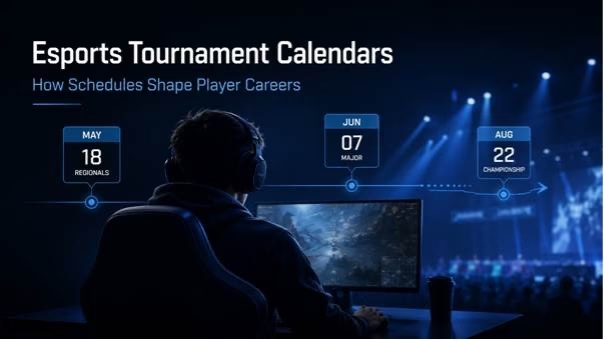
A tournament calendar may appear to be a neutral list of dates, venues, brackets, and travel windows. For players, it operates as a career map. It tells them when to intensify practice, when to preserve energy, when to appear publicly, and when to move from private preparation into visible performance. In competitive gaming, the calendar shapes the player before the match begins.
That is why tournament planning deserves closer attention in esports coverage. Research on esports training, periodization, and software observes that competitive gaming still lacks a settled model for structuring training, planning, and career stages, as players and teams operate inside demanding seasonal rhythms. This creates a gap between what viewers see and what players do. Modern esports careers are not built around isolated matchdays. They are built around recurring windows that coordinate practice, recovery, travel, analysis, communication, and public identity.
II. The Calendar as Competitive Structure
The same principle becomes clearer when esports is compared with poker, another competitive discipline in which schedules are visible before decisions begin. Players need to know when formats start, how long events may run, whether the setting is online or live, and what rhythm the format creates. A page for online poker tournaments is useful in that context because it presents tournament play as a scheduled structure, with event times, game formats, registration states, and tournament types in one place.
Such details matter because calendars tell competitors how much attention an event demands. A short session asks for a different warm-up than a longer field. A scheduled start creates a different mental runway than a quick-start format. When readers look at online poker tournaments through this lens, the point is practical comparison: tournament careers are built around repeatable structures that help players plan energy, study windows, travel blocks, format choices, and public-facing moments.
A brief visual example makes that pressure less abstract. In this Xuan Liu tournament-life video, the emphasis is not limited to play at the table. It points toward the wider rhythm surrounding high-level poker: travel, preparation, major stages, community content, and the routines around competition. The event date is the public marker. Around it sit quieter layers that determine whether a player arrives prepared, settled, and sharp enough to perform under attention.
III. Preparation and Travel Implications
In esports, a calendar gives players permission to narrow their focus. A team preparing for a regional final may spend more time on opponent tendencies, map selection, scrim quality, and communication habits. A player preparing for an arena event may account for sleep timing, stage noise, equipment consistency, media duties, and the shift from private repetition to public execution.
The calendar does not create skill on its own. It determines what kinds of work are realistic. A 2-week block before a qualifier is rarely the moment to rebuild an entire playstyle. It is usually for refinement, confidence, and repetition. A longer off-season is different. That is when teams can test roles, adjust coaching priorities, and rebuild fundamentals without immediate bracket pressure.

Three questions reveal what a tournament schedule silently demands:
- Compression: How much preparation must fit into a short window?
- Transition: How often must a player change setting, format, or opponent type?
- Continuity: Does the season reward steady development or sudden adaptation?
Those questions matter because calendars are not neutral. A crowded run can favor players who already have stable routines. A wider gap can favor teams willing to experiment. A live event can reward composure under pressure. An online event can reward comfort, repeatability, and reset habits.
Travel adds another layer. Online competition preserves familiar routines, while live events ask players to carry those routines into unfamiliar spaces. Hotel sleep, practice rooms, delayed call times, changed meal patterns, stage lighting, and media commitments affect a player’s readiness. The public sees the match time and scoreline. Teams see flight timing, warm-up space, review notes, rest blocks, and the next opponent approaching.
Strong organisations treat these transitions as part of performance. They do not assume a player will feel ready because the bracket says it is time. They build systems around the date: practice rhythms, review habits, sleep protection, equipment consistency, and clear communication. The best version of a competitor is rarely produced by intensity alone. It is produced by repeated readiness.
IV. Conclusion
Tournament calendars also shape identity. A player who appears regularly becomes easier for fans to follow. A team that returns to major events gives its audience a story to track. Even a difficult result becomes part of the season because the next date creates context. The calendar turns scattered appearances into a visible career arc.
Tournament schedules deserve to be read as more than listings. They define pressure, reveal priorities, and show how competitive lives are organised. The strongest calendars do more than announce events. They develop the habits behind repeatable performance: resilience, stress tolerance, sustained attention, cooperation, communication, and adaptability, all highlighted in research on psychological factors in esports performance.


