General
Esports Betting in Ireland in 2026 and the Evolution of Regulation
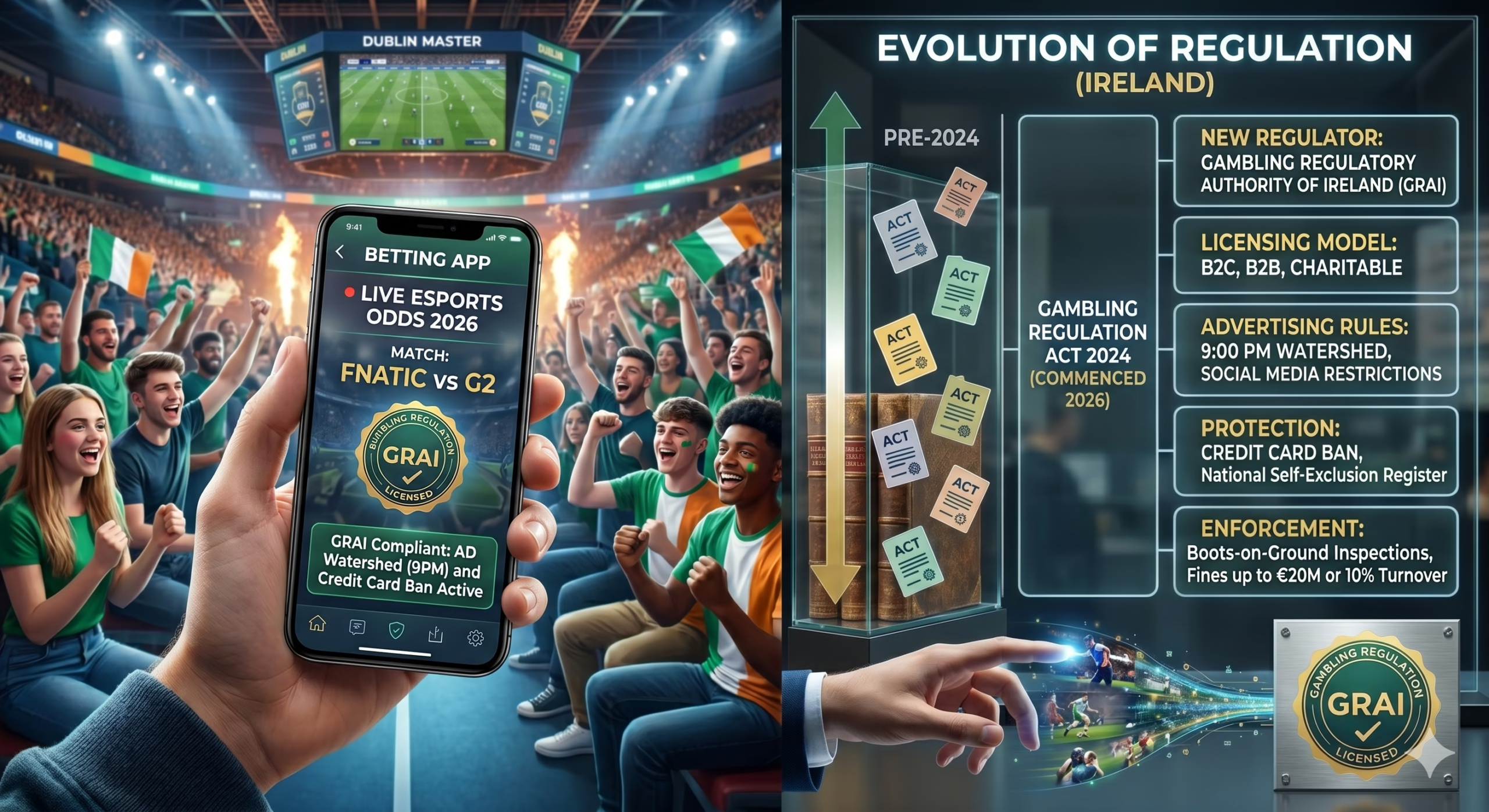

Esports betting has edged its way into the mainstream in Ireland in a way that would have seemed unlikely even a few years ago. It is no longer treated as a niche extension of gaming culture or something that sits slightly outside the traditional betting conversation. Instead, it is being drawn into the same regulatory space as more established markets, whether it fits neatly there or not. That shift has been driven as much by necessity as by growth. Once money, scale and visibility reach a certain level, regulation tends to follow, and that is exactly what is happening here.
The Shape of Ireland’s New Regulatory Framework
The introduction of a central regulatory authority has changed the tone of the conversation quite noticeably. There is now a clearer sense of structure, even if some of the finer details are still settling into place. Licensing requirements, compliance checks and enforcement powers are no longer scattered across older legislation but brought together under a more unified approach. On paper, esports betting falls into this system without too much friction. It is treated as another form of wagering, subject to the same broad expectations.
The problem arises when one tries to figure out how to implement such standards into practice. In terms of conventional sports, and especially football, there exists a well-established system that has undergone decades of development. The principles for organizing contests, collecting statistics, and maintaining fairness are well-known. However, in esports, everything may look quite differently. Each game has its own regulations. Furthermore, the dynamic nature of each ecosystem requires making certain adjustments to regulate things properly.
Market Maturity and Structural Differences
The gap between these markets becomes clearer when you look at how they behave over time. In football, particularly in the Premier League, things tend to follow a rhythm that people recognise. Teams don’t usually change overnight. You see them develop over a season or two, you get a feel for where their strengths lie, and even their weaknesses become fairly predictable. Over time, the data builds up in a way that feels dependable rather than reactive.
Esports doesn’t always give you that same sense of continuity. Rosters can change from one event to the next, formats shift, and sometimes a title itself can lose relevance quicker than expected. It makes it harder to pin down what “long term” really looks like, because the ground can move underneath you a bit more often. Comparisons with more established markets are useful here, if only to highlight what stability looks like. In structured betting options such as Premier League outright odds where consistency of competition and depth of historical data allow expectations to form over time the contrast with newer esports betting markets becomes easier to see. It is not a question of one being better than the other, but of one having had longer to find its shape.
From what I have seen, regulators are aware of this, even if the response is still evolving. Treating both markets in exactly the same way risks overlooking the differences that actually matter.
Data Reliability and the Question of Integrity
Most of this comes back to data, even if it is not always discussed in those terms. In football, particularly at the top level, there is a level of standardisation that tends to be taken for granted. Tracking systems are aligned, event data follows consistent definitions, and there is a general confidence in how information is captured and used.
Esports is a little more uneven in that respect. Data can come from multiple sources, each with its own processes and priorities. In some cases, it is tied closely to game publishers or tournament organisers, which adds another layer of complexity. That does not mean the data is unreliable, but it does mean it is not always uniform.
From a regulatory standpoint, that raises some awkward questions. If a market is built on data that varies in quality or availability, where does responsibility sit if something goes wrong. It is not always obvious, and that lack of clarity is something regulators will need to keep returning to.
Regulatory Pressure and Industry Adaptation
There are already signs that the sector is adjusting, even if most of it is happening quietly. You don’t really see it from the outside, but behind the scenes operators are tightening things up. Compliance processes are getting more attention, data handling is being looked at more closely, and there’s a growing sense that eSports betting can’t remain loosely defined if it’s going to sit comfortably within a regulated framework.
However, there are some areas in which regulation must catch up. Esports does not stand still for long. Titles evolve, competitive scenes expand or contract, and new formats appear with little warning. That pace does not always align neatly with how legislation develops. It is not necessarily a flaw, but it does mean that regulation will often be reacting rather than anticipating.
From my perspective, that tension is likely to persist. The idea that a single framework can neatly contain something as fluid as esports feels optimistic, even if the intention behind it is understandable.
Trust as the Defining Factor
If there is one thread running through all of this, it is trust, though not in the abstract sense it is often presented. It shows up in smaller ways. If people feel good about what they see, if results seem believable, if the process seems to hold together. In leagues such as the Premier League, that faith has been developed painstakingly, to the extent that it might be taken for granted rather than questioned.
The field of esports has not quite reached that level of confidence yet, although there have been advances, and perhaps even more than could have been anticipated. The Irish legal framework provides structure, but it does not automatically translate into trust. That still depends on how consistently the system performs over time.
What stands out to me is that regulation here is not just about control. It is also about trying to give a developing market enough structure to become credible without restricting how it grows. That is not a straightforward task, and it is unlikely to be resolved in a single iteration of the rules.
A Market Still Finding Its Shape
Esports betting in Ireland feels like it is somewhere in between. It is clearly part of the wider gambling landscape now, but it has not fully settled into the patterns that define more traditional markets. There is a sense of adjustment on all sides, with regulators, operators and the industry itself still working out where the edges are.
The Premier League will still provide a good example of what could be done by esports, but not because it provides a template that can be copied. Rather, it gives an idea of where we would be if we waited long enough for everything to settle down and stabilise.
In the meantime, the line must be drawn very carefully. It cannot be too strict, or else we might undermine the trust of our audience. At the same time, we must remember how fast things move when it comes to the world of esports. This will almost certainly change with time.


