Labor&Immigration
What To Do When A Professional Gamer Is Owed Money From An Esports Team, Tournament Organizer, or Sponsor? – 7 Solutions
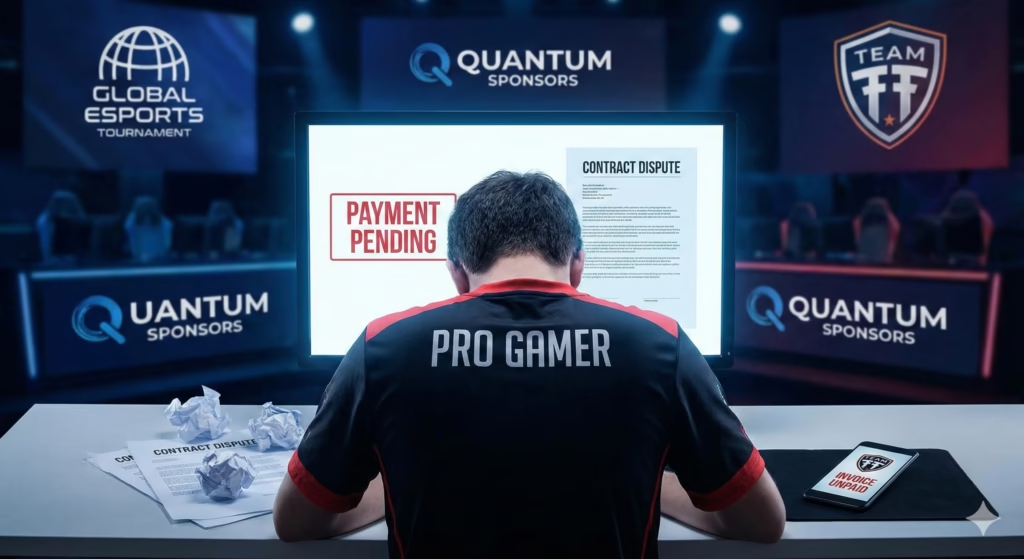

While less common than it once was in the esports industry, there have been several public instances where competitive players alleged that they were owed funds (sometimes large sums) from esports teams, tournament and event organizers as well as other third-party companies such as brands and sponsors. Many of these disputes ended with the esports organization, event organizer, or sponsor paying the owed funds.
In other cases, these amounts remain outstanding as a result of the company potentially shut down entirely or otherwise declaring bankruptcy. In many cases, this outcome does not favor a gaming talent owed potentially large amounts from these parties. However, in instances where an esports organization, tournament organizer, or sponsor continues to operate, professional esports players, coaches, casters, and team and organizer personnel have options to attempt to legally remedy these payment deficiencies.
The following is not intended as legal advice because every situation and contract is different, accordingly, a competent and experienced attorney specializing in esports, entertainment, and digital media should be engaged to properly vet any potential course of action. In fact, the information in this article is intended to provide a quick glimpse into the potential avenues, remedies, and best practices when a professional video gamer is owed money from a third party. It should not be taken as legal advice and is for educational purposes only.
1. Review Your Agreement (If One Exists).
First, it is crucial for an individual who has a written agreement with the party owing them money is aware of and reviews the contract’s terms and conditions. It is important to focus on the payment terms including the schedule and conditions for payment. For instance, the agreement might list how long before a payment is made to the talent (i.e., “Net-30,” “Net-60,” or sometimes longer). It may require the gaming talent to provide an invoice or some other written request for the funds to be issued before the third-party initiates payment. The agreement might also list whether any late penalties or interest apply to any past due amounts.
Similarly, an esports player should be aware of the applicable termination clauses as well as any breach and notice provisions. These paragraphs are important to review because they set the procedures for providing proper and actionable notice to the breaching party for failing to adhere to the contract terms such as not making the appropriate or timely payment to the talent.
For example, a notice provision might outline the method of delivery, such as by Express or Certified mail, and specify which parties and at what addresses to send the breach notices for them to be effective. The clause will also outline the time the breaching party has to “cure” or remedy any noticed breach which could be 30 days (or more or less).
If the breaching party cures the enumerated breaches by making the payments owed and fixing any other violations, the agreement would remain operable. However, if the esports team, sponsor, or any other third party fails to timely cure any listed violations within the specified timeframe, the agreement could be considered breached. As a result, the contract typically outlines the rights a non-breaching party has when a properly noticed breach remains uncured. In these cases, an uncured breach could potentially provide the non-breaching party with the immediate right to terminate the contract and attempt to recover both legal and equitable remedies such as monetary damages and potentially injunctive or other declaratory relief.
2. Do Not Violate Confidentiality and Non-Disclosure Provisions.
Many esports player and talent agreements include confidentiality and other “non-disclosure” provisions. These clauses are intended to prevent the parties from publicly disclosing confidential or other non-public and proprietary information related to their relationship which may include contract terms (including payment amounts). As a result, individuals who are owed money may violate these written restrictions by publicly disclosing that a dispute between the player and the team or sponsor is ongoing or exists. For instance, these actions could be seen as a violation of these covenants if a competitive gamer speaks with a news reporter or makes a social media post regarding an alleged outstanding debt.
This act could potentially be seen as defamatory if it is later proven false. Despite “truth” being a potential defense, such public actions could potentially violate other contractual provisions and damage the other party’s business or reputation. Consequently, the gamer might then be subjected to potential legal ramifications for these actions including monetary ones. A public disclosure could also potentially mitigate the owed party’s desire or ability to repay the debt and resolve the matter as they could potentially be insolvent or otherwise unable to remedy the outstanding amounts, and the negative public discourse would most likely not benefit the breaching party.
Therefore, in most cases, it is advantageous and it is usually prudent for an esports player owed money from an esports team, tournament organizer, or sponsor to confidentially and privately attempt to negotiate a resolution and settlement before publicly disclosing the dispute. In these cases, engaging an attorney or other third-party representative would not be seen as a violation of these types of provisions and such actions are usually explicitly permitted and could be advantageous to the party.
3. Review Prize Distribution and League and Tournament Participant Guidelines.
In addition to any signed agreement, an esports event organizer or league operator generally has established rules and regulations regarding its competition. These documents are sometimes publicly accessible and in other cases, they may be obtained from the relevant organizing company. These documents typically include information addressing how and when prize money is distributed to the participants as well as how the prize money is allocated among the competitors. As a result, a gamer owed prize money should be aware of any applicable tournament and league rules as well as any game publisher and developer guidelines related to such disbursements. Consequently, these documents would also factor into the distribution of any previously accrued funds.
4. Provide Appropriate Notice and Maintain Copies of Payments and Written Correspondence.
As mentioned above, it is crucial that a party owed money follows all contractual requirements for providing proper notice under any applicable agreement including maintaining copies of all certified receipts and “tracking” information. In many cases, the talent themselves or a third-party representative such as an attorney, may draft and issue a formal notice in the form of a “demand letter” to the breaching party.
This letter issued to the breaching party provides the party with written notice pursuant to the agreement of any breaches including the failure to make any owed payment. The correspondence lists any owed sums and demands repayment of said amounts within the time listed in the contract to cure such a breach. The written notice starts the applicable cure period and acts as potential evidence for future disputes.
Moreover, it is prudent that a gamer maintains copies of all written correspondence between the parties including any payment invoices, signed contracts, bank statements, emails, Discord, and any other written messages sent by the relevant parties. This information is valuable when describing the steps undertaken by the parties to remedy any dispute as well as providing clarity into any previous requests for payment.
Related to this action, an individual owed prize money should maintain copies of any public announcements, social media posts, media reports, and any other publicly distributed information related to the prize money and any payout information to substantiate the potential amounts due to them. These written communications are especially relevant when no signed agreement or contract exists between the parties.
5. Dispute Resolution Options – Court or Alternative Dispute Resolution (ADR)?
If the parties are unable or unwilling to resolve any properly noticed dispute, then the dispute resolution terms of the agreement may be operable. If a signed agreement exists between the parties, the dispute resolution terms will guide and apply. The provision might mandate a specific court to adjudicate any contractual disputes including listing the state and county as well as whether federal or state court is appropriate. If there is no information related to this fact, the party can choose the most appropriate forum of adjudication based on the sums owed which could be “small claims” court for smaller amounts or federal or state courts for larger amounts (where all the appropriate jurisdictional requirements are satisfied).
Alternatively, some agreements mandate alternative dispute resolution instead of court which could include mandatory arbitration or mediation. Some contracts may specify which adjudicating organization must be used and which rules must apply. For example, the document might mandate the usage of a specific organization for adjudication of any contractual disputes such as the Judicial Arbitration and Mediation Services, Inc. (JAMS), the American Arbitration Association (AAA), or the International Games and Esports Tribunal (IGET) (operated by the Esports Integrity Commission (ESIC) and the World Intellectual Property Organization Arbitration and Mediation Center (WIPO AMC)). In these cases, the individual must file the appropriate initiating documents with the appointed dispute resolution organization and adhere to its listed rules.
In addition, or prior to initiating one of the above dispute resolution mechanisms, some contracts require that the parties engage in good faith negotiations to resolve any disputes for a set time before filing a lawsuit or serving a request for arbitration. Thus, it is beneficial to review the applicable the dispute resolution and choice of law contractual clauses.
6. Be Aware of What Future Money Is Due.
The unique nature of esports and digital media means that professional gamers and gaming talent may be owed money that they did not receive yet which may be outlined within an applicable agreement. For instance, a party may be due future money from an esports team such as tournament or prize money not yet dispersed to the team but that is owed to the player. Similarly, a competitor player may receive a portion of an esports team’s “sticker,” “skin,” or other “in-game” digital item revenue which is only payable to the talent after the esports organization receives it from the game publisher or developer.
Therefore, such sums should also be memorialized and factored into any potential demand or settlement. Similarly, a player or sponsorship agreement might provide bonuses for certain milestones or achievements such as sales or team or player “ranking” ones. Thus, a gamer should also be aware of any future money payable to them under the contract for any performance incentives and bonuses as well as for any future royalty or commission due to them that may be calculated and payable to the gamer in the future.
7. Act, Do Not Wait (Before It’s Too Late).
While the above is intended to outline some potential matters that a professional gaming talent involved in a payment dispute should be aware of, it is crucial that a party acts quickly and does not wait until they are in dire need of the funds before they begin defending themselves. While it is not true in every case, the longer the sums are unpaid, the less likely they will be recovered. This fact is due to the assumption that the sums will continue to increase with additional amounts being due as well as any potential interest.
Additionally, if outside representatives or counsel are engaged to assist in attempting to recover the money, the gamer’s damage, costs and expenses continue to increase, which causes the owed sum to grow. Again, the best advice is to get specific information related to a person’s particular matter as soon as possible as the longer a party waits, the more likely the outstanding amount will continue to increase without a resolution.


