Gambling
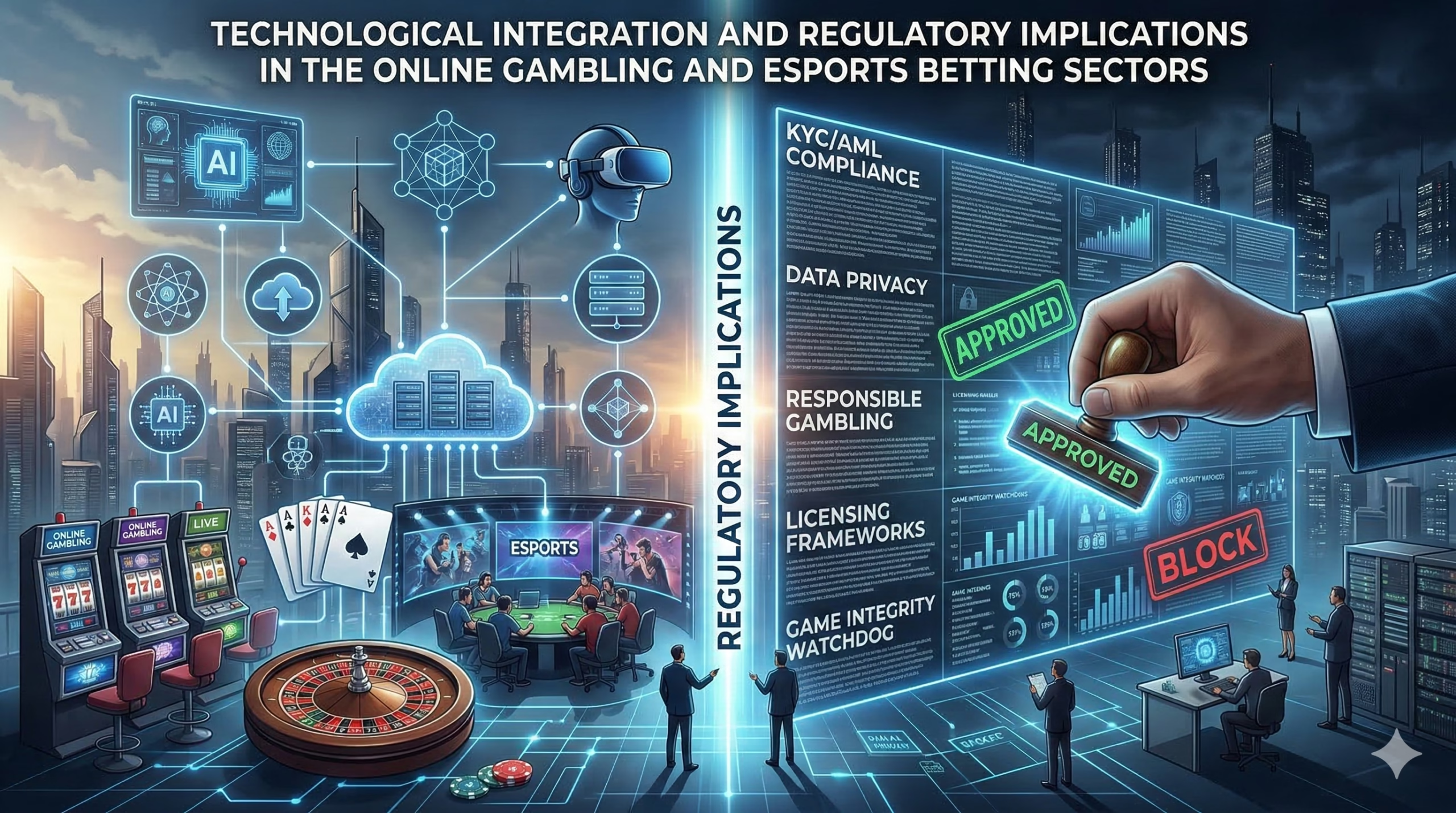
Technological Integration and Regulatory Implications in the Online Gambling and Esports Betting Sectors

Introduction
The online gambling industry has expanded at a remarkable pace over the past decade, driven by continuous advancements in digital technology and the proliferation of global internet infrastructure. What was historically confined to traditional brick-and-mortar establishments has effectively transitioned into a highly sophisticated digital ecosystem, enabling players to access thousands of gaming options and dynamic esports betting markets seamlessly across jurisdictions. Modern digital casinos and sportsbooks are required to deliver far more than rudimentary virtual iterations of slot machines or table games. Today’s consumer base demands highly immersive experiences, rigorous security within payment architectures, and bespoke gaming environments. Consequently, technological integration has emerged as the primary catalyst for structural innovation and market competitiveness within the sector.
Operators are continuously deploying novel technological frameworks to optimize platform performance, fortify security protocols, and maximize user engagement. Innovations across artificial intelligence, decentralized blockchain networks, virtual reality, and mobile-first gaming platforms are fundamentally restructuring operational models and consumer interaction paradigms. These technological deployments not only elevate the end-user experience but also generate critical avenues for operators to acquire and retain market share in a heavily scrutinized industry.
Artificial Intelligence and Risk Management
Artificial intelligence has established itself as an indispensable utility for online gambling and prediction platforms. By aggressively analyzing extensive volumes of player data, artificial intelligence systems can isolate behavioral patterns and curate highly personalized user experiences. A primary application of this technology is the deployment of algorithmic game recommendations and dynamic esports odds. Digital operators continuously aggregate data concerning player behavior, encompassing preferred game variants, favorite competitive esports titles, wagering cadences, and session durations. Machine learning algorithms subsequently process this telemetry to surface gaming options or upcoming Counter-Strike 2 match markets that align precisely with a user’s historical preferences.
Furthermore, artificial intelligence underpins targeted marketing and promotional compliance. Rather than deploying uniform promotional campaigns across an entire user base, operators can dynamically calibrate bonuses based on distinct user activity profiles. By evaluating participant behavior, platforms can identify which promotional structures are most effective for specific market segments. As a practical example, an operator’s algorithm might deploy a free USD 50 pokies with no deposit promotion to engage lower-budget participants, while concurrently directing lucrative reload bonuses toward high-volume players focused on international League of Legends tournaments.
Crucially, artificial intelligence serves as the backbone for fraud detection and institutional risk management. These automated systems are capable of auditing thousands of financial transactions in real time to identify highly suspicious activities, including account manipulation, bonus abuse, and anomalous betting patterns. By identifying these irregularities at an early stage, operators can proactively shield their financial infrastructure and protect their legitimate user base.
Virtual Reality and Digital Immersion
Virtual reality and augmented reality technologies are actively redefining the experiential framework of online gambling and esports spectating. Diverging from traditional, two-dimensional interfaces, VR technology permits users to navigate fully realized digital casino environments and virtual esports arenas. Within these immersive spaces, participants can traverse a virtual gaming floor, approach distinct operational tables, or watch live esports broadcasts alongside peers in real time, successfully replicating the ambient social dynamics of a physical venue or LAN event.

These digital environments concurrently enhance the realism of traditional table games. Participants can engage with virtual blackjack or roulette setups managed by professional digital dealers, while avatars represent the active participants. This capacity to interact directly with dealers and competitors introduces an unprecedented layer of immersion. Furthermore, virtual reality architecture heavily supports social gaming functionalities, allowing networks of friends to occupy the same virtual space, spectate ongoing matches, and communicate directly during gameplay. While the infrastructure for virtual reality casinos remains in a developmental phase, it represents a highly promising vector for the future expansion of the online gambling and competitive gaming sectors.
Blockchain Architecture and Digital Asset Integration
Blockchain technology has fundamentally restructured the baseline for transparency and security within the online gambling ecosystem. By leveraging decentralized ledgers, operators can securely log financial transactions and gaming outcomes in a strictly immutable format that cannot be subsequently altered or manipulated. A critical application of this distributed ledger technology is the establishment of provably fair gaming. While traditional digital casinos require users to place intrinsic trust in the operator’s software, blockchain systems utilize cryptographic algorithms that empower players to independently verify the absolute randomness and fairness of game results.
Additionally, this technology ensures comprehensive transparency for all financial settlements. Blockchain networks record operational deposits and withdrawals on public ledgers, drastically reducing the institutional risk of financial disputes or ledger manipulation. In tandem with these networks, cryptocurrencies have gained substantial traction as primary payment methodologies, particularly among the digitally native demographic that drives esports betting. A growing contingency of online platforms now processes transactions utilizing digital assets such as Bitcoin, Ethereum, and affiliated tokens. These alternative payment channels yield distinct functional advantages, including accelerated cross-border settlements, diminished transaction processing fees, and an elevated degree of financial privacy for the consumer.
Mobile Ecosystems and Cross-Platform Accessibility
Mobile computing technology has arguably served as the most significant catalyst for the global expansion of the online gambling market. As the processing power of smartphones and tablets has escalated, consumer preference has decisively shifted toward mobile access over traditional desktop interfaces. Consequently, modern operators routinely implement a mobile-first developmental approach, designing their platforms primarily for smartphone users. Responsive web design guarantees that gaming software and live-betting slips operate fluidly across an array of device specifications and screen dimensions.
The deployment of dedicated mobile applications has also become an industry standard. These proprietary applications permit users to securely access their accounts, initiate gameplay, and authorize financial transactions directly from their handheld devices—a critical feature for bettors placing in-play wagers during fast-paced esports events. The mobile ecosystem provides critical consumer benefits, notably immediate market access regardless of geographic location, expedited authentication processes, and seamless integration with hardware-based biometric security systems.
Another vital technological advancement is the seamless implementation of cross-platform compatibility. Modern infrastructure allows a participant to initiate a gaming session on a desktop terminal and flawlessly transition to a mobile device without experiencing a disruption in progress. This architectural flexibility systematically increases player retention and overall operational convenience, playing a critical role in the continued capitalization of the global digital gambling market.
Legal and Regulatory Analysis
The rapid deployment of these digital frameworks introduces complex regulatory hurdles that operators must navigate to maintain multi-jurisdictional compliance. The integration of artificial intelligence relies entirely on processing massive datasets of user telemetry, which immediately triggers stringent data privacy obligations under frameworks like the General Data Protection Regulation and the California Consumer Privacy Act. Operators face immense legal pressure to ensure algorithmic transparency, particularly to prove that automated risk management systems and targeted promotional engines do not unlawfully discriminate against specific consumer demographics or exploit vulnerable participants.
Furthermore, the adoption of blockchain architecture and cryptocurrency payments creates significant friction with traditional anti-money laundering regulations. While distributed ledgers offer transactional transparency, the pseudo-anonymous nature of digital asset wallets complicates the strict Know Your Customer protocols mandated by international gaming authorities. Regulators require operators to definitively identify the source of funds, an obligation that becomes increasingly opaque within decentralized finance ecosystems. Consequently, platforms integrating crypto-assets must deploy highly sophisticated on-chain forensic tools to satisfy regulatory audits.
Finally, the shift toward mobile-first and virtual reality platforms heavily amplifies geolocation compliance liabilities. Jurisdictional boundaries dictate the legality of esports betting and casino access, requiring operators to utilize infallible, tamper-proof geolocation services to enforce territorial fencing. A failure to accurately geolocate a mobile user can result in severe federal penalties, particularly in the United States under statutes like the Wire Act. Additionally, relying on biometric authentication on mobile devices subjects operators to secondary liability regarding the secure storage and processing of highly sensitive physiological data.

Strategic Conclusions
Digital technology continues to iterate upon the online gambling and esports prediction industries at an accelerated velocity. Artificial intelligence drastically refines user personalization and institutional security, while blockchain infrastructure injects requisite transparency and verifiable trust into digital financial settlements. Concurrently, immersive frameworks like virtual reality are structurally redefining the consumer experience, while mobile ecosystems ensure frictionless, cross-device market access. For operational entities, these continuous innovations unlock novel commercial opportunities, provided they can adeptly navigate the corresponding legal frameworks. For the consumer, they guarantee a more secure, engaging, and highly convenient operational platform. As digital frameworks mature, the broader online gambling sector is positioned to become increasingly interactive, customized, and technologically robust.