Gambling
Why Esports Still Lacks a Unified Regulatory Framework for Betting

Introduction
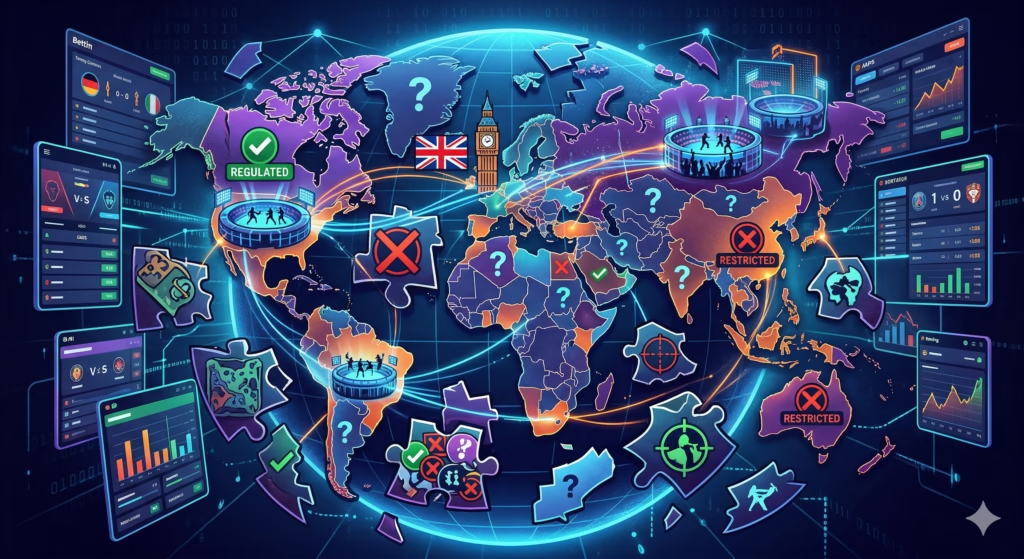
For something that’s supposed to be global, esports still feels oddly fragmented when it comes to betting rules.
On the surface, it looks like it should be straightforward. Everything is online, the audiences are international, and most of the activity already happens across borders anyway. But once you start digging into how betting is actually regulated, it gets messy pretty quickly.
There isn’t one system holding it all together. It’s more like a mix of different rules depending on where you are, some stricter than others, and in a few cases, barely there at all.
A Global Industry With Local Rules
Part of the issue is that esports doesn’t really belong to one place. You can have a tournament hosted in one country, teams joining from several others, and viewers placing bets from somewhere completely different. It sounds simple until regulation comes into it, because gambling laws are still tied to specific regions.
In the UK, there’s at least something clear to follow with the UK Gambling Commission setting the rules. Once you step outside of that, it’s not quite as straightforward.
Some countries are tighter on it, others aren’t as strict, and in a few places it’s a bit unclear what the rules even are. So instead of everything lining up under one system, it feels more like different approaches sitting side by side, not always matching up.
The Problem With Defining Esports
There’s also the question of what esports actually is, at least from a legal point of view.
Traditional sports have had decades, sometimes longer, to settle into clear structures. Governing bodies, standard rules, recognised formats. But Esports frameworks haven’t caught up yet.
Each game is published by a different company with its own set of rules and regulations. There are differences in formats and different competitive communities. It lacks an overall governing body. That makes regulation harder to pin down. What applies in one game might not make sense in another.
Integrity Risks Are Still a Concern
Without a shared framework, it just makes things harder to keep on top of. Match-fixing has cropped up here and there, usually in the lower-tier events where there isn’t as much oversight to begin with. That’s where things tend to slip. Betting markets can add another layer to that if no one’s really watching closely, especially when you put it next to something like casino games, for example blackjack or other casino table games where the expectations around fairness are a lot clearer and more established due to RTP percentages.
Some organisers have tried to tighten things up, adding monitoring tools or integrity checks, but it’s not consistent. A lot of it depends on who’s running the event or which game is involved. And that inconsistency tends to leave gaps.
Technology Moves Faster Than Regulation
Another thing that doesn’t help is how quickly everything moves. Esports change fast. New titles come through, formats shift, audiences move with them. Regulation doesn’t really work like that. It takes time, usually reacting to problems rather than getting ahead of them.
So there’s often a lag. By the time rules are in place, the scene has already moved on slightly. You can see it with newer betting markets as well. They tend to appear before anyone has properly decided how they should be handled.
Operators Are Filling the Gaps
Because there isn’t a single framework, a lot ends up falling on the operators themselves. Some take it seriously, putting systems in place to track unusual betting patterns or flag suspicious activity. Others are less consistent. It varies more than you might expect.
There’s no universal standard here. What one platform treats as a red flag, another might not even pick up on.
Why a Unified Framework Is Still Out of Reach
In theory, having one global system would make things easier. Clearer rules, more consistency, less room for confusion.
But getting there is another story. Different countries approach gambling in very different ways. Legal systems don’t line up, cultural attitudes don’t either, and then you’ve got game publishers who effectively control their own ecosystems on top of that. There isn’t an obvious body that could realistically pull all of this together.
Where Things Go From Here
For now, it looks like esports betting will stay as it is, at least for a while. There will probably be improvements. More cooperation between regulators, better monitoring, maybe some level of standardisation over time. But a fully unified system doesn’t feel close.
The industry is still evolving, and regulation is still trying to keep up with it. And until that balance settles, it’s likely to remain a bit uneven.


