
IP
Blizzard’s StarCraft Broadcasting Rights and Copyright Law: Control of Esports Broadcasting

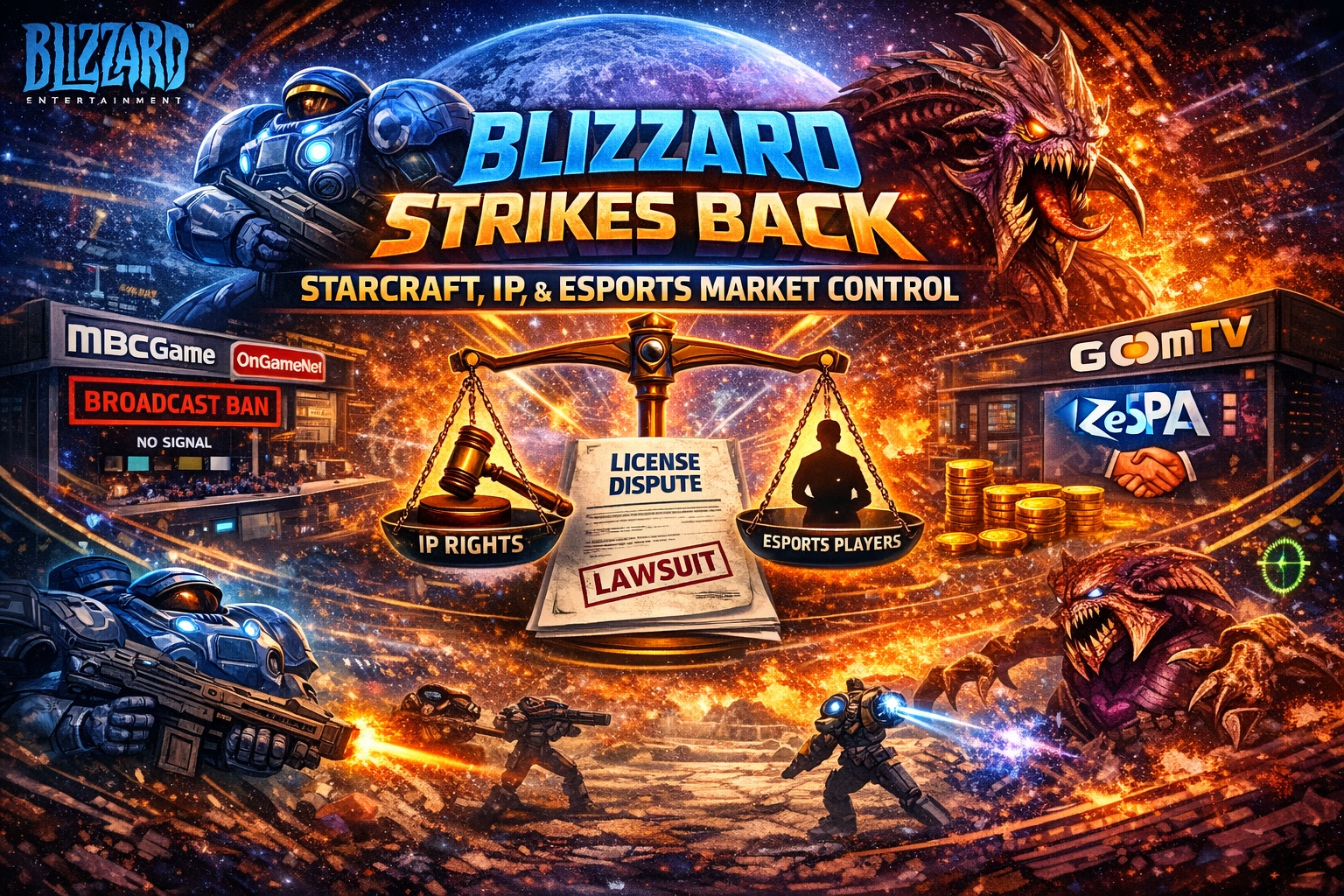

Table of Contents
Introduction
The dispute over Blizzard Entertainment’s StarCraft broadcasting rights marked a pivotal turning point in who controls the broadcast of professional esports matches. Esports competitions take place entirely within proprietary digital environments owned and controlled by private publishers, raising novel questions regarding the extent to which player-generated competitive activity.
The StarCraft controversy was Blizzard Entertainment’s assertion that, as the copyright holder of the StarCraft franchise, it possessed the exclusive legal authority to authorize and license the public broadcast of professional matches, notwithstanding the creative labor and competitive skill contributed by players and teams. In 2010, Blizzard sued South Korean cable broadcaster, including MBCGame and OnGameNet, for airing StarCraft: Brood War tournaments without a sublicense from Blizzard or its designated Korean partner, Gretech (operating through GomTV).[1]
Blizzard had earlier severed longstanding ties with the Korean e-Sports Players Association (KeSPA), claiming that KeSPA had sold television rights without the company’s consent and had failed to respect Blizzard’s intellectual property. Korean broadcasters and KeSPA argued that these professional competitions constituted independent performances and that Blizzard’s assertion of exclusive rights threatened established industry practice.
More than a disagreement over licensing fees or brand management, the StarCraft broadcasting rights conflict represented a pivotal structural shift in esports governance. By asserting centralized control over tournament broadcasts, Blizzard advanced a publisher-centric governance model that reordered power among copyright holders, broadcasters, and competitive communities. The dispute ultimately pushed major stakeholders toward negotiated settlements, in which rights, responsibilities, and licensing frameworks were clarified. It signaled a shift toward contract-based regulation of esports content, which continues to shape how competitive esports is organized, commercialized, and legally governed worldwide.
StarCraft Broadcasting Rights: Navigating Copyright in Competitive Gaming
The dispute over the televised broadcast of StarCraft competitions arose from Blizzard Entertainment’s assertion that unauthorised transmission of gameplay footage infringed its copyright. Blizzard maintained that StarCraft is both a computer program and an audiovisual work, and that a televised match necessarily reproduces and publicly performs protected elements of that work. This position is in accordance with copyright law. US courts have consistently recongised video games as copyrightable audiovisual works. In Stern Electronics, Inc. v. Kaufman, the Second Circuit held that the sights and sounds produced during gameplay were sufficiently original and fixed to qualify for protection. This principle highlights the view that broadcasts, which display these audiovisual elements, are protected.[2]
In the late 2000s and early 2010s, StarCraft was a cultural phenomenon in South Korea, broadcast by major cable channels such as OnGameNet and MBCGame without formal licenses from Blizzard. According to the Korean Times, “classifying StarCraft and other e-sports as part of the public domain deprives developers such as Blizzard of their IP rights.”[3] Therefore, Blizzard’s stance triggered negotiations and eventual court actions beginning in 2010, as the company sought to assert control over how and to whom its game content was broadcast.
Professional StarCraft matches are emergent performances shaped by the decisions of players, not pre-authored sequences. While Blizzard created the underlying software and audiovisual assets, it neither scripts nor foresees the specific flow of a particular match. Treating the broadcast of such competitive play as simply reproducing Blizzard’s copyright risks ignoring the contribution of players’ skill and creativity, raising questions about how traditional copyright categories apply to esports. “The game company’s presumptive copyright protection over a particular background, game item, or action response does not defeat the possibility of a derivative copyright.”[4] Thus, creators who build upon existing game elements must still ensure that their contributions demonstrate sufficient originality to qualify for independent copyright protection.
Industry commentary on game streaming and broadcasting indicates broader uncertainty about the scope of copyright in interactive contexts. Academic analysis of video game streaming finds that while game companies technically retain the right to stop unauthorised streaming. Most do not exercise that right, given the promotional value of such broadcasts; it also suggests that, in some cases, streamers might qualify for some rights over the audiovisual recordings of their play.[5]
The historical context of the StarCraft dispute further complicates the legal landscape. For more than a decade before Blizzard sought exclusive broadcasting rights, Korean broadcasters aired StarCraft tournaments with Blizzard’s tacit approval, helping establish the game as a national cultural phenomenon. Critics of Blizzard’s late enforcement have argued that such conduct may have created implied permissions and reliance interests, even if formal copyrights were not forfeited.[6]
Blizzard StarCraft: IP and Licensing
The Blizzard StarCraft broadcasting rights dispute demonstrates how intellectual property and contract law can function as mechanisms of contract-based regulation rather than merely as tools for the protection of creative works. Blizzard’s assertion of exclusive authority over broadcast licensing. Yet, the enforcement restructured an entire competitive market. By withdrawing recognition from KeSPA and reallocating licensing authority through an exclusive agreement with GOMTV, Blizzard displaced an entrenched industry framework that had coordinated leagues, teams, and broadcasters for over a decade.[7] This illustrates how formal legal entitlement can override institutional arrangements that had achieved de facto legitimacy through long-term industry reliance.
From a legal perspective, Blizzard’s position in the StarCraft broadcasting rights dispute rested on a straightforward application of title-based licensing principles. The dispute exposes how brittle such doctrines become when applied to industries structured around informal governance. KeSPA’s authority was commercially accepted for years, yet once Blizzard reasserted control, that legitimacy was retrospectively nullified. The Blizzard Starcraft broadcasting rights dispute, therefore, illustrates how strict contractual analysis can destabilise settled markets when long-standing institutions are reclassified as legally insufficient.
By appointing a single entity to operate leagues and negotiate broadcast arrangements, Blizzard consolidated control over the StarCraft competitive ecosystem.[8] Although exclusivity is a common commercial mechanism and not unlawful per se, its sudden deployment in this context had far-reaching consequences.
Korean cable broadcasters that had invested heavily in StarCraft programming were excluded unless they accepted Blizzard’s revised licensing framework. For gamers and professional teams, this restructuring altered revenue flows, visibility, and competitive opportunities. The Blizzard StarCraft broadcasting rights dispute thus demonstrates how contract law can operate as a mechanism of private regulation. By allowing a rights holder to reshape an industry without legislative intervention or judicial determination.
Therefore, the absence of competition law scrutiny is striking, as StarCraft occupied an exceptional cultural and economic position in South Korea. Yet the dispute unfolded largely through private ordering rather than public regulatory oversight.[9] This illustrates the extent to which publishers exercise quasi-regulatory power through intellectual property ownership and licensing control. For gamers, this explains why tournament access and professional viability may hinge less on competitive merit than on publisher consent.
The Blizzard StarCraft dispute offers a clear warning that reliance on intermediary organisations without verified underlying rights creates systematic exposure. Even good-faith contractual reliance provides limited protection when the asserted authority of an industry body collapses under formal scrutiny.
StarCraft Broadcasting Dispute: Litigation and Market Control
The Blizzard StarCraft broadcasting rights dispute is particularly interesting when analysed through the lens of litigation strategy and remedial uncertainty. Blizzard’s intention to pursue litigation against MBC for continuing to air StarCraft competitions without securing publisher authorisation.[10] A core element of the litigation was the implicit availability of injunctive relief. In copyright law, injunctions are particularly powerful in media disputes because they can immediately halt ongoing broadcasts and disrupt established revenue streams.
Blizzard’s legal position drew support from U.S. law recognising video games as protected audiovisual works, strengthening the argument that televised gameplay constitutes a public performance of copyrighted expression.[11] However, translating this doctrinal foundation into effective relief in South Korea posed significant obstacles. The dispute unfolded in a jurisdiction where StarCraft broadcasting had been deeply embedded in national media culture, and where courts would have had to weigh copyright enforcement against entrenched industry practice and public interest consideration.[12] These procedural and institutional uncertainties made litigation a high-risk strategy.
Claims for damages would likely have presented further difficulties. As StarCraft broadcasts in Korea had historically occurred without licensing fees, Blizzard would have faced substantial challenges in demonstrating quantifiable economic harm. The tolerance of free broadcasts would have complicated any attempt to calculate lost revenue with precision and would have weakened the equitable case for injunctive relief.[13]
Blizzard achieved its commercial objectives through negotiated arrangements rather than through the creation of binding precedent. The settlement structure enabled Blizzard to consolidate control over StarCraft broadcasting rights without requiring a court to determine whether competitive gameplay broadcasts constitute copyrightable public performances or alternative characterisations like sporting events facilitated by software might apply.
Players, teams, and broadcasters must navigate complex rights arrangements and adapt business models to comply with publishers’ expectations, even when the law itself remains unsettled. The StarCraft case also highlights how negotiation, rather than adjudication, can serve as the primary mechanism for resolving conflicts over content distribution in digital media.
This dispute demonstrates that in rapidly developing digital markets, market power, strategic enforcement, and private negotiations can establish de facto legal norms even in the absence of formal precedent. Even though courts could not elaborate on the fundamental questions raised, Blizzard’s actions effectively set the rules for how esports broadcasting operates in practice.
Conclusion
In conclusion, Blizzard’s assertion of exclusive control over the broadcast of professional matches frames televised games as reproductions and public performances of copyrighted audiovisual elements. While U.S. law encompasses the protection of video game audiovisuals, applying these principles to competitive esports raises complex questions. Professional matches are emergent performances driven by player decisions, yet Blizzard claims effectively treated them as pre-authored content. This approach risks oversimplifying the intersection between developer rights and the creative contributions of players, potentially stretching copyright law beyond its traditional scope.
The long-standing practice of broadcasting StarCraft without formal licenses, combined with deeply embedded cultural norms, complicated claims for damages or injunction. By centralising licensing through GOMTV and sidelining KeSPA, Blizzard achieved control without judicial oversight, demonstrating that market power and IP enforcement can substitute for legal adjudication. While effectively commercial, this outcome leaves unresolved fundamental questions about how copyright law should recognize or accommodate emergent, player-driven performances within interactive media.
Players were central to the StarCraft ecosystem, generating the competitive content that drove viewership and revenue, yet they had limited formal control over how their performances were broadcast or monetized. While their skill, strategy, and creativity shaped each match, the exclusive copyright being held by Blizzard effectively subordinated players ‘ contributions to developer ownership.
Legally, this case illustrates the potential for IP and contract law to function as tools of private regulation. Blizzard’s settlement-driven strategy allowed the company to reshape an entire market, dictate broadcaster and team behavior, and assert de facto authority over competitive play. The StarCraft dispute exposes how copyright, licensing, and contractual enforcement can consolidate power, often without clarifying underlying legal doctrines.
Ultimately, the Blizzard StarCraft dispute showcases that while IP law can protect creative works, it can also be wielded strategically to control markets, potentially at the expense of players, intermediaries, and broader legal clarity. The case illustrates that in emerging digital markets, legal authority is frequently shaped less by court rulings than by the strategic deployment of rights by dominant actors, who can set operational norms, enforce standards, and restructure industries without formal oversight.
[1] Brian Leahy, ‘Blizzard Sues Korean Television Network Over Unauthorised StarCraft: Brood War Tournament,’ (ShackNews, 2010). https://www.shacknews.com/article/66277/blizzard-sues-korean-television-network
[2] Stern Electronics, Inc v Kaufman, 669 F.2d 852 (2d Cir. 1982).
[3] Kim Tong-hyung, ‘Blizzard vows to take MBC to court,’ (The Korean Times, 2010). https://www.koreatimes.co.kr/business/tech-science/20101202/blizzard-vows-to-take-mbc-to-court
[4] Holden, J., & Schuster, M. (2021). Copyright and Joint Authorship as a Disruption of the Video Game Streaming Industry. Columbia Business Law Review, 2020(3). https://journals.library.columbia.edu/index.php/CBLR/article/view/7815.
[5] Ibid.
[6] Lau Kok Keng, Edina Lim and Yong Yi Xiang, ‘Legal and Regulatory Issues in Video Gaming and Esports (Part 2), (2024), Centre for Technology, Robotics, Artificial Intelligence & the Law. https://law.nus.edu.sg/trail/legal-and-regulatory-issues-in-videogaming-esports-p2/
[7] Kim Tong-hyung, ‘StarCraft broadcasting dispute headed to court,’ (The Korean Times, 2010). https://www.koreatimes.co.kr/business/companies/20101025/starcraft-broadcasting-dispute-headed-to-court
[8] Stephen Ellis, ‘Esports is growing up: IP law and broadcasting rights,’ (ESPN, 2016). https://www.espn.com/gaming/story/_/id/14644531/ip-law-broadcasting-rights-esports
[9] Jeremy Reimer, ‘The Dawn of Starcraft: e-Sports come to the world stage,’ (ArsTechnica, 2011). https://arstechnica.com/gaming/2011/03/the-dawn-of-starcraft-e-sports-come-to-the-world-stage/
[10] Kim Tong-hyung, ‘Blizzard vows to take MBC to court,’ (The Korean Times, 2010). https://www.koreatimes.co.kr/business/tech-science/20101202/blizzard-vows-to-take-mbc-to-court
[11] Copyright Act, 17 U.S.C. § 101
[12] Kim Tong-hyung, ‘StarCraft broadcasting dispute headed to court,’ (The Korean Times, 2010). https://www.koreatimes.co.kr/business/companies/20101025/starcraft-broadcasting-dispute-headed-to-court
[13] Ibid.


