
Compliance & Regulatory
Fortnite iOS Japan: How Apple’s Predatory 21% Commission Destroyed the Launch

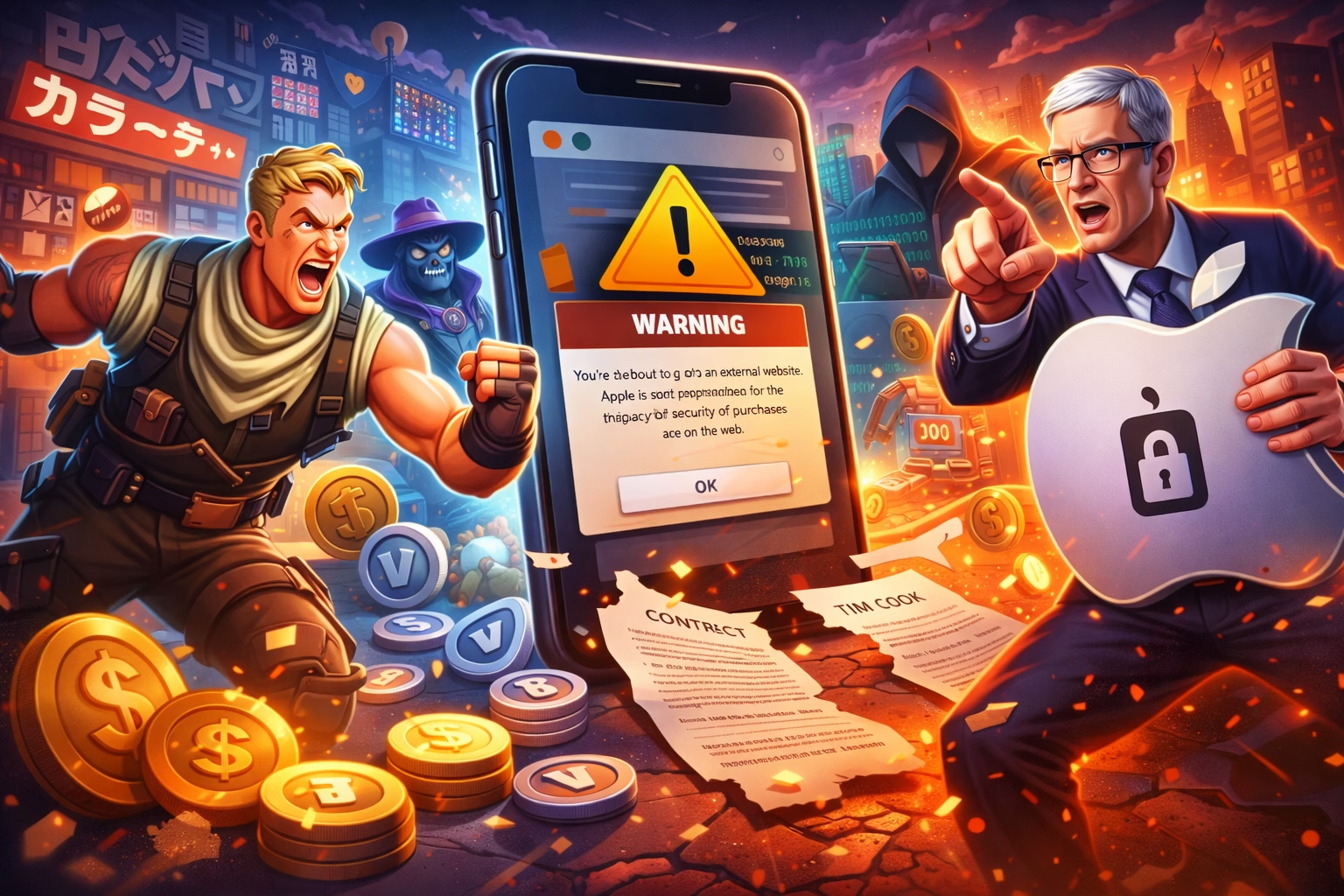

Table of Contents
Introduction
On December 18, 2025, Japan’s Mobile Software Competition Act (MSCA) took effect, requiring Apple to permit alternative app stores and payment methods on iOS devices.[1] The same day, Epic Games CEO Tim Sweeney announced that Fortnite would not return to iOS in Japan, describing Apple’s compliance as “another travesty of obstruction and lawbreaking in gross disrespect to the government and people of Japan.”[2] Epic had announced in June 2024 that the Fortnite iOS Japan launch would occur in late 2025, celebrating the MSCA as “a big win for mobile gamers and developers.”[3] Six months later, those plans collapsed when Apple revealed its compliance framework.
The Fortnite iOS Japan controversy exposes the limits of competition legislation when platforms control both technical infrastructure and user interfaces. Competition law (antitrust law in the United States) aims to prevent companies with market power from blocking rivals and harming consumer choice. In the Fortnite iOS Japan situation, Japan’s MSCA required Apple to open its platform, but Apple responded with fees and restrictions that achieve market closure through different means. Apple’s implementation demonstrates a sophisticated form of regulatory evasion known as malicious compliance: technically satisfying legal requirements while systematically undermining their purpose.
For Fortnite’s 400 million global players, including millions in Japan who have been unable to access the game on iOS since August 2020, the Fortnite iOS Japan situation demonstrates how competition laws can fail when platforms control the infrastructure determining whether market access is economically viable.
This article examines three mechanisms Apple deployed: extractive pricing structures that exceed costs Apple incurs, warning screens that function as competitive deterrents, and surveillance requirements that compromise developer business confidentiality. For gamers, these mechanisms determine whether games like Fortnite can offer better prices and experiences. For lawyers, they represent case studies in how dominant firms evade competition law through technical compliance.
Extractive Pricing Under Regulatory Compliance
Apple’s fee structure for the Fortnite iOS Japan market demonstrates how regulatory compliance can weaponize monopoly power. Under the MSCA framework, Apple charges: 26% for in-app purchases using Apple’s payment system (reduced from 30%), 21% for third-party in-app payments, 15% for external payment links, and a 5% Core Technology Commission for apps distributed through alternative marketplaces.[4] The 21% fee on third-party payments is what Epic Games identified as the primary barrier preventing the Fortnite iOS Japan return.[5]
When developers use Apple’s payment system at 26%, Apple processes transactions, handles refunds, manages subscriptions, and assumes chargeback risk (when customers dispute charges). These services justify a commission tied to transaction costs. However, when developers use their own payment processors in the Fortnite iOS Japan scenario, Apple provides none of these services. The developer assumes all transaction risk, manages customer relationships, and bears processing costs (typically 2-3%). Yet Apple charges 21%, a fee that cannot be justified by any service Apple renders.[6]
When players buy V-Bucks (Fortnite’s in-game currency) on PlayStation or Xbox, those platforms charge Epic about 30% but provide the payment infrastructure, refund handling, and customer support. Under Apple’s Fortnite iOS Japan rules, if Epic processes the payment itself, meaning Epic does all the work, and Apple still takes 21%. Epic gets charged almost as much for doing everything themselves as for letting Apple handle it.
The economic effect of the Fortnite iOS Japan situation is to make alternative payment options economically nonviable. Developers using third-party processors must pay Apple 21%, plus their own payment processor’s 2-3% fee, plus the costs of website infrastructure, customer support, and promotional expenses to overcome Apple’s deterrent warnings. The total frequently exceeds Apple’s 26% commission.[7] This is precisely the outcome Apple designed: offer “choice” that no rational developer would select. For Fortnite, which operates on 5-15% profit margins after development costs, server infrastructure, and content creation, the Fortnite iOS Japan fees eliminate the business case.
This pricing strategy mirrors Apple’s response to the 2021 anti-steering injunction in Epic Games v. Apple.[8] Anti-steering provisions are contractual clauses preventing businesses from directing customers to alternatives. Think of it like a mall forbidding stores from telling shoppers about better prices at competing malls. For iOS, these provisions prevented developers from including links or buttons directing users to external payment options. Judge Rogers ruled that Apple’s prohibition on directing users to alternative payment options violated California’s Unfair Competition Law and issued a permanent injunction.[9]
In April 2025, Judge Rogers found Apple in “willful violation” of her injunction, which can lead to criminal contempt charges. Apple “chose not to comply with this Court’s Injunction” and “did so with the express intent to create new anticompetitive barriers which would, by design and in effect, maintain a valued revenue stream.”[10]
The court identified that Apple’s replacement scheme achieved “the same anticompetitive ends as its original practices, using the same economic mechanism.”[11] Rather than using contractual prohibitions, Apple used “pricing and design tactics to raise rivals’ costs by making it more difficult for users to discover and substitute to lower-cost sellers.”[12]
This is precisely the strategy Apple deployed in the Fortnite iOS Japan situation. The MSCA required Apple to permit alternative payments. Apple complied by permitting them while charging fees that make alternatives economically irrational. In December 2025, the Ninth Circuit Court of Appeals unanimously affirmed Judge Rogers’s contempt finding, holding that “Apple claimed to comply with the injunction, but it instead prohibited developers from using buttons, links, and other calls to action without paying a prohibitive commission to Apple, and it restricted the design of developers’ links to make it difficult for customers to use them.”[13]
The legal question in the Fortnite iOS Japan controversy is whether this constitutes genuine compliance with the MSCA’s statutory purpose or whether it represents the kind of bad-faith implementation that U.S. courts have rejected. Judge Rogers explicitly rejected Apple’s justifications: “Apple has not offered any justification for the actions other than to argue entitlement. Where its actions harm competition and result in supracompetitive pricing and profits, Apple is wrong.”[14]
Supracompetitive pricing means prices above competitive market levels, a core indicator of monopoly power. Apple has not demonstrated that the 21% fee corresponds to any cost it incurs or value it provides when developers use their own payment systems.
For developers, particularly gaming companies like Epic Games that operate Fortnite on thin margins in highly competitive markets, the Fortnite iOS Japan fees represent a business-model impossibility. Fortnite’s business model depends on direct relationships with players, frequent content updates, and cross-platform progression. Your skins, battle passes, and V-Bucks work on PlayStation, Xbox, PC, and mobile. Apple’s 21% fee on third-party payments eliminates the economic rationale for the Fortnite iOS Japan launch, even with the MSCA nominally permitting alternative distribution and payment methods.[15]
Warning Screens as Competitive Weapons
Apple’s MSCA implementation for Fortnite iOS Japan includes mandatory warning screens that appear when users select alternative payment options. These screens inform users that they are “no longer transacting with Apple,” that Apple-provided services like refunds “will not be available,” and that users “may need to share their payment information with additional parties, which can introduce new privacy and security risks.”[16] Tim Sweeney described these as “anticompetitive warning screens” designed to “mislead customers into believing their privacy and financial security are at risk when dealing with Apple competitors.”[17]
For gamers considering the Fortnite iOS Japan situation: you are buying V-Bucks, and Apple shows you a screen saying “WARNING: This payment is risky. Apple cannot help you if something goes wrong. Your financial information might not be secure.”[18] Most players would back out immediately, even though Epic processes millions of secure transactions daily across every other platform. That is precisely the intended effect: to make users fear alternative payment options.
The warning screens function as what behavioral economists call “dark patterns,” interface designs that exploit cognitive biases to steer users toward platform-preferred choices. Dark patterns include tactics like making unsubscribe buttons tiny and hidden, or pre-checking boxes for expensive options. By framing alternative payments as risky in the Fortnite iOS Japan context, Apple leverages its position of trust with iOS users to create reputational harm for competitors before any transaction occurs. This is particularly effective because most users lack the technical sophistication to evaluate payment security claims and will default to the option the platform endorses as “safer.”
From a legal perspective relevant to the Fortnite iOS Japan controversy, these warnings constitute anti-steering provisions that U.S. courts have found violate competition law. In her 2021 ruling, Judge Rogers identified anti-steering as preventing “informed choice among users of the iOS platform” and violating “the policy and spirit of antitrust laws because anti-steering has the effect of preventing substitution among platforms for transactions.”[19]
Warning screens that systematically characterize alternatives as dangerous serve the same function as contractual prohibitions: they prevent users from selecting competing payment options. The Ninth Circuit’s December 2025 ruling affirmed that Apple “restricted the design of developers’ links to make it difficult for customers to use them.”[20]
The privacy and security justifications Apple asserts for these warnings in the Fortnite iOS Japan implementation do not withstand scrutiny. Developers who use their own payment processors are subject to the same PCI DSS (Payment Card Industry Data Security Standard) compliance requirements as Apple. PCI DSS is the global security standard for handling credit card data, covering everything from encryption to fraud detection.
Major companies like Epic Games, which handles millions of Fortnite transactions across multiple platforms daily, maintain security infrastructure equivalent to or exceeding Apple’s. The suggestion that users face materially greater risk transacting with Epic in the Fortnite iOS Japan scenario than with Apple is not supported by breach data or industry practice.
Moreover, Apple itself permits developers to link to external websites for purchases in certain contexts without warning screens. Reader apps (such as Spotify, Netflix, and Kindle) have long been permitted to direct users to websites for subscription purchases without Apple imposing deterrent warnings.[21] This inconsistency reveals that the warnings are not driven by genuine security concerns but rather by competitive considerations: Apple imposes warnings when alternative payments threaten App Store revenue. Games like Fortnite face warnings that streaming apps do not, despite identical payment security standards.
For Epic Games and the Fortnite iOS Japan launch, these warning screens represent an insurmountable barrier even if the fee structure were resolved. Epic’s business model depends on players making frequent small purchases for cosmetic items (skins, emotes, pickaxes), battle passes, and in-game currency. If every purchase attempt for the Fortnite iOS Japan version triggers a warning that the transaction is risky and that Apple cannot help if something goes wrong, player conversion rates will plummet. The warning screen transforms what should be a seamless two-click transaction into a moment of friction and doubt, directly undermining the user experience that makes free-to-play games economically viable.
Japan’s MSCA does not explicitly prohibit warning screens, a drafting oversight that Apple has exploited to block the Fortnite iOS launch in Japan. The statute requires Apple to permit alternative payments but does not regulate how Apple characterizes those alternatives to users. This gap between statutory language and practical effect demonstrates the sophistication required in competition legislation: it is insufficient to mandate access if the gatekeeper retains the power to undermine that access through interface design. The Fortnite iOS Japan situation shows how platforms can comply with regulations while ensuring compliance achieves nothing.
The Surveillance API and Platform Control
Perhaps most concerning in the Fortnite iOS Japan situation is Apple’s mandatory reporting API for alternative app stores. Tim Sweeney characterized this as Apple imposing “a new 5% junk fee on all revenue from apps distributed by competing stores, intending to surveil all transactions within them using a mandatory reporting API.”[22] An API (Application Programming Interface) lets different programs communicate. Apple’s mandatory API means every alternative app store must automatically report all business data back to Apple.
Any developer operating through an alternative marketplace (like the Epic Games Store launching in Japan in January 2026)[23] must integrate Apple’s API and report all transactions.[24] This grants Apple complete visibility into competitor operations: customer acquisition costs, pricing strategies, conversion rates, and revenue. For the Fortnite iOS Japan launch, Apple would see exactly how many players download Fortnite, what they spend, and when. Alternative stores become data conduits for their direct competitor.
The surveillance serves multiple anticompetitive functions. First, Apple can monitor whether alternative stores succeed and adjust policies to undermine that success. Second, it creates compliance costs and technical dependencies, disadvantaging competitors. Third, it compromises developer confidentiality.
The 5% Core Technology Commission funding for this surveillance appears lower than the 30% App Store commission, suggesting alternative distribution is attractive. However, the 5% applies to all revenue from alternative stores, not just digital goods. If Epic distributes the Fortnite iOS Japan version with both in-app purchases and advertising, Apple receives 5% of advertising despite providing no transaction services.[25]
Tim Sweeney’s hypothetical illustrates the absurdity: “Can you imagine the gamer and regulator uproar that would ensue if Microsoft required all games on Steam and the Epic Games Store to use its commerce surveillance API and report all transactions back to Microsoft?”[25] No PC gamer would accept Microsoft imposing surveillance on competing stores. Yet Apple has implemented this in the Fortnite iOS Japan market under MSCA compliance. The difference: iOS users cannot switch mobile operating systems like PC gamers can choose between Windows and other platforms.
The surveillance API raises antitrust concerns under Japanese law and international standards. Mandatory information sharing with a dominant competitor constitutes self-preferencing, a platform using its gatekeeper position to advantage its own services. The European Commission identified such practices as core DMA violations: gatekeepers must not use data from business users to compete with those users.[26] Apple’s requirement violates this principle.
For Epic Games, surveillance is a deal-breaker for the Fortnite iOS Japan launch beyond the fee objections. Epic operates alternative stores to escape Apple’s control over pricing, content, and strategy. Mandatory reporting undermines this purpose. Epic would share detailed data on player spending and monetization with a competitor that has blocked Fortnite from iOS since August 2020. Fortnite generates approximately $5-6 billion annually. Apple’s demand for access to this intelligence in the Fortnite iOS Japan situation is equivalent to a landlord requiring tenants to report all sales data to competing businesses.[27]
Malicious Compliance and the Limits of Competition Law
The Fortnite iOS Japan controversy reveals a fundamental tension: statutory language mandating access does not guarantee functional competition when gatekeepers control the economic infrastructure determining whether access is viable. Apple’s MSCA implementation constitutes “malicious compliance” satisfying legal requirements while systematically undermining its spirit through fees, warnings, and surveillance designed to preserve monopoly power.
Apple has responded to competition legislation in the EU, Japan, South Korea, and U.S. courts with superficially compliant changes, maintaining its revenue extraction and control. The April 2025 U.S. contempt finding shows courts are recognizing this strategy. Judge Rogers ruled Apple “willfully chose not to comply” with “the express intent to create new anticompetitive barriers.”[28] But judicial intervention requires years of litigation and is reactive rather than preventive. The Epic v. Apple dispute began in August 2020. Five years later, the Fortnite iOS Japan launch remains blocked through mechanisms courts have condemned.
Effective competition legislation must regulate how gatekeepers characterize, price, and monitor access. Statutes should prohibit fees exceeding documented costs, ban interface designs discouraging alternatives, and restrict data collection, granting gatekeepers visibility into competitor operations. The MSCA mandated Apple open iOS to competition but did not define what “competition” means in practice. The Fortnite iOS Japan outcome shows that formal access without economic viability is not competition at all.
For Epic Games and the Fortnite iOS Japan launch, iOS in Japan remains inaccessible despite the MSCA. The 21% fee makes alternative payments economically irrational, warning screens undermine user confidence, and the surveillance API compromises independence. For millions of Fortnite players in Japan who have waited five years, Apple’s malicious compliance means indefinite exclusion.
If Apple’s MSCA implementation stands, it establishes that platform compliance can take the form of “choices” no reasonable business would select, transforming competition law from a tool for market opening into formalism satisfied by nominal gestures while market power persists. Japan’s Fair-Trade Commission must decide whether to accept Apple’s implementation as satisfying the MSCA or recognize it as the bad-faith compliance U.S. courts found unlawful. The answer determines whether the Fortnite iOS Japan launch can proceed and whether competition legislation can constrain digital gatekeepers. For gamers seeking access to their preferred games and lawyers seeking effective competition remedies, the stakes are immense.
[1] ‘Japan Forces Apple to Allow Alternative App Stores’ (19 December 2025) Gadget Hacks https://apple.gadgethacks.com/news/japan-forces-apple-to-allow-alternative-app-stores/
[2] Emma Collins, ‘Fortnite Will Not Return to iOS in Japan in 2025’ (19 December 2025) 80.lv https://80.lv/articles/fortnite-will-not-return-to-ios-in-japan-in-2025
[3] ‘Fortnite and The Epic Games Store will be arriving on iOS in Japan in 2025’ (17 June 2024) PocketGamer.biz https://www.pocketgamer.biz/fortnite-and-the-epic-games-store-arriving-on-ios-in-japan-in-2025/
[4] ‘Japan’s Smartphone Act Implemented and Targets Apple and Google’s App Store Business’ (2 January 2026) Lexology https://www.lexology.com/library/detail.aspx?g=7817d634-4f13-4548-a82d-094796e57ca3
[5] Sarah Perez, ‘Apple Opens Up Its App Store to Competition in Japan’ (18 December 2025) TechCrunch https://techcrunch.com/2025/12/18/apple-opens-up-its-app-store-to-competition-in-japan/
[6] ‘Japan’s Smartphone Act Implemented’ (n 4).
[7] Ibid.
[8] Epic Games, Inc v Apple, Inc (ND Cal, 10 September 2021).
[9] Ibid.
[10] Ibid.
[11] ‘AAI Counsels Ninth Circuit on Trial Courts’ Broad Powers to Enjoin Monopolistic Conduct’ (26 August 2025) American Antitrust Institute https://www.antitrustinstitute.org/work-product/aai-counsels-ninth-circuit-epic-v-apple-monopolistic-conduct/
[12] ‘Epic Games’ Ninth Circuit Win Affirming Civil Contempt Finding’ (11 December 2025) Cravath https://www.cravath.com/news-insights/epic-games-ninth-circuit-win-affirming-civil-contempt-finding.html
[13] ‘The Apple v. Epic Decision’ (14 September 2021) Stratechery https://stratechery.com/2021/the-apple-v-epic-decision/
[14] Epic Games, Inc v Apple, Inc (ND Cal, 30 April 2025) No 4:20-cv-05640-YGR (Order Granting Motion to Enforce Permanent Injunction) (citing the District Court’s September 2021 findings on supracompetitive pricing).
[15] ‘Fortnite Not Coming to iOS in Japan as Epic Games CEO Accuses Apple of ‘Obstruction and Lawbreaking” (18 December 2025) MacRumors https://www.macrumors.com/2025/12/18/fortnite-japan-fee-complaints/
[16] Japan App Store Gets Alternative Marketplaces, Third-Party Payments and More’ (18 December 2025) MacRumors https://www.macrumors.com/2025/12/17/japan-app-store-feature-updates/
[17] Collins (n 2).
[18] John Koetsier, ‘External iOS Payments for In-App Purchases Now Live: 3 Big Problems’ (19 January 2024) Singular https://www.singular.net/blog/external-ios-payments/
[19] ‘Epic Games’ Ninth Circuit Win Affirming Civil Contempt Finding’ (11 December 2025) Cravath https://www.cravath.com/news-insights/epic-games-ninth-circuit-win-affirming-civil-contempt-finding.html
[20] ‘Epic Games’ Ninth Circuit Win Affirming Civil Contempt Finding’ (11 December 2025) Cravath https://www.cravath.com/news-insights/epic-games-ninth-circuit-win-affirming-civil-contempt-finding.html
[21] The Apple v. Epic Decision’ (14 September 2021) Stratechery https://stratechery.com/2021/the-apple-v-epic-decision/
[22] Mixed Ruling on Epic’s Antitrust Challenge to Apple’s App Store’ (27 August 2025) Fenwick https://www.fenwick.com/insights/publications/mixed-ruling-on-epics-antitrust-challenge-to-apples-app-store
[23] Collins (n 2).
[24] Perez (n 5).
[25] ‘Apple Announces Changes to iOS in Japan’ (17 December 2025) Apple Newsroom https://www.apple.com/newsroom/2025/12/apple-announces-changes-to-ios-in-japan/
[26] ‘Japan’s Smartphone Act Implemented’ (n 4).
[27] Collins (n 2).
[28] ‘New Third-Party iOS App Stores in Japan Preserve User Privacy, Child Safety’ (18 December 2025) AppleInsider https://appleinsider.com/articles/25/12/18/new-third-party-ios-app-stores-in-japan-preserve-user-privacy-child-safety


