Labor&Immigration
Rockstar Layoffs: Worker Rights, Esports’ Structural Challenge & FIFPro’s Model
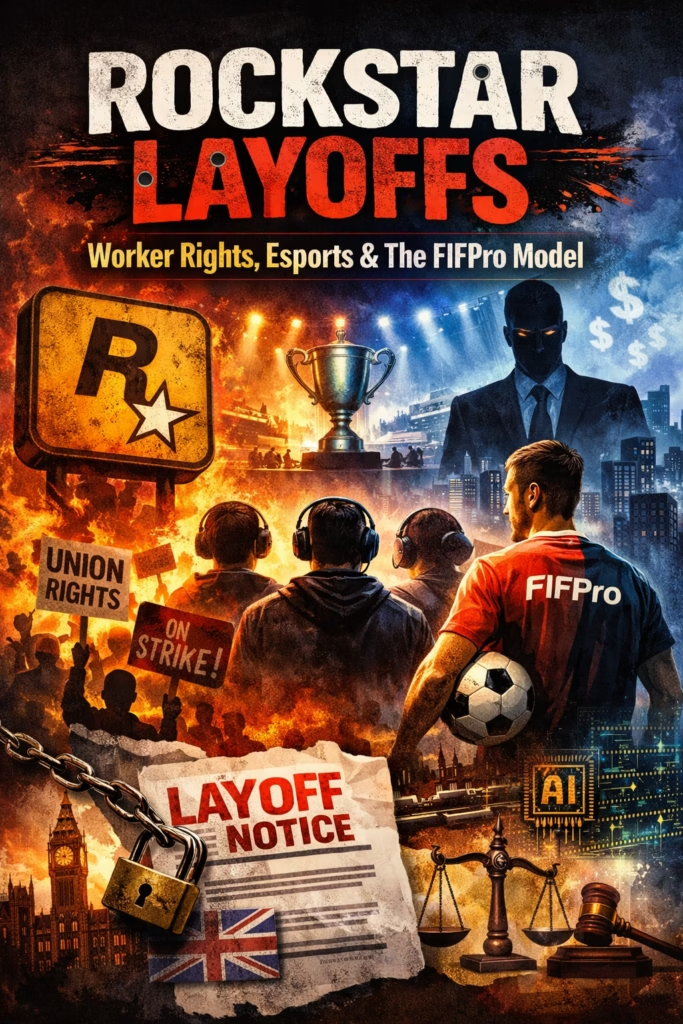

The gaming and esports industries have long been defined by layoffs and job instability. Recent developments are only accelerating these issues in an already volatile industry. The increasing integration of Generative AI in game development and major transactions, such as the acquisition of Electronic Arts, signal a new dimension of labor risk.
It is against this backdrop of heightened tension that the current legal and political battle involving Rockstar Games has erupted. Rockstar Games is one of the largest game developers worldwide, with its upcoming GTA 6 game expected to be one of the best-selling titles of all time.1 The controversy predominantly surrounds Rockstar North, a British studio of Rockstar Games, based in Edinburgh, Scotland.2
Union Busting Allegations
The situation arose following the sudden firing of over 30 employees by Rockstar Games, with the majority based in Edinburgh, at Rockstar North.3 The gaming giant claimed the dismissals were due to ‘gross misconduct’ by the employees, setting up a Discord server to discuss and distribute, per Rockstar: “confidential information in a public forum, in breach of company policy and their legal obligations”.4
According to Rockstar, the employees used the server to discuss, amongst others, “specific game features from upcoming and unannounced titles”.5 A report by People Make Games revealed that the employees shared a message from Rockstar management regarding changes to the company’s Slack message policy on the server, which is believed to be Rockstar’s legal justification for the layoffs.6
The fired employees, on the other hand, claim that the Discord server was a closed forum, created in 2022, meant only for Rockstar members who were showing an interest in unionisation, joined by representatives from the Independent Workers of Great Britain (IWGB) union.7
Reportedly, the union had organised around 200 members before the layoffs, a significant threshold which potentially made it eligible for formal recognition and bargaining with management.8 Hence, IWGB, now representing the let-off workers, claim that Rockstar’s actions amount to Union Busting.9 Union busting is a tactic by employers to break and remove potential trade unions in order to secure a non-union workforce.10 In a statement, the IWGB asserted that the layoffs were
“the most blatant and ruthless act of union busting in the history of the games industry,” made with “flagrant contempt for the law and for the lives of the workers who bring in their billions“.11
IWGB believes Rockstar did not want their employees to unionise, as a union would enable the employees to lobby for higher pay or shorter hours, and it would also make it harder to keep potentially unflattering reports of mistreatment private.12
The fired employees comprise of team leads, senior artists, programmers, and more, some of whom were on sick leave, paternity leave, and some could now potentially lose their UK work Visas.13 The employees still working at Rockstar are now expressing fear of losing their jobs, saying: “Morale in the studio is at rock bottom. When we should be excited about what’s to come over the next year we are now totally deflated and our trust and confidence in others is totally shot”.14
Political Scrutiny
This controversial situation made its way up to the UK’s Parliament on the 10th of December, when local MP Chris Murray told the Prime Minister: “The video games company Rockstar in my constituency last month fired 31 employees without providing evidence or union representation… The IWGB alleges union busting. Having met Rockstar they failed to reassure me they are following employment law and I share concerns about union busting”.15
In response, Sir Keir Starmer termed the situation as a “deeply concerning case”, reassuring that “Every worker has the right to join a trade union and we’re determined to strengthen workers rights and ensure they don’t face unfair consequences for being part of a union. Our ministers will look into the particular case that he [Murray] raises and will keep him updated“.16
MP Chris Murray recalled that when attempting to discuss the matter with Rockstar directly, in a meeting joined by fellow Edinburgh MPs, a significant disagreement arose over the need to sign a non-disclosure agreement (NDA): “The meeting began with us as MPs refused entry unless an NDA was signed, a request they eventually withdrew after it being made clear this would not be signed”.17
The meeting, according to Murray, did not alleviate any of his concerns, as he claims he was not convinced, nor assured, that Rockstar’s process was aligned with UK employment law, stating that they failed to inform him of the actual reason for the employees’ dismissal.18
The involvement of the government signals that this case transcends a typical labor law dispute, raising fundamental questions about the balance of power between game studios and their employees.
Unionisation in Esports: A Fragmented System vs. The FIFPro Model
The outcome of this situation will likely set a crucial precedent for the gaming and esports industry, as a long standing issue is the lack of player and developer unions.19
Indeed, the lack of unionisation represents two sides of the same coin: on one side, we see the suffering of the employees of game publishers, as evidenced by the Rockstar situation; on the other, we see professional players in esports often being exploited. In both instances, the proprietary control held by publishers allows them to ‘exploit’ both grounds, as neither has the bargaining power to challenge the publisher’s decisions.
Esports specifically, according to scholar Roshan Patel, currently lags behind traditional sports in terms of unionisation, although “esports players have many differences that may put them in a better position to achieve unionisation”.20
Rather than unions, the gaming and esports world is filled with Player Associations (PAs) instead. Player Associations fight for player rights but are not formal unions, meaning they lack the key elements of legal protection and formal bargaining power.21 For example, Riot Games has a player association, which it calls a union. However, it is not formally recognised by the federal government, and thus, it lacks legal protection and doesn’t have any formal obligations under federal law.22
Relating to Roshan Patel’s point, comparing esports with traditional sports, a stark contrast can be drawn with the FIFPro Model. The International Federation of Professional Footballers (FIFPro) is the only worldwide representative for professional football players, promoting the interests of over 65,000 professional female and male players.23
FIFPro engages in important activities like global collective bargaining, legal representation, and workload monitoring. Crucially, FIFPro is acknowledged by FIFA as the official representative of professional footballers worldwide.24 For example, when FIFA released the schedule of the FIFA Club World Cup, FIFPro were able to file a legal claim against FIFA based on players rights under the EU charter, claiming that “the right to a guaranteed annual break has become virtually non-existent, with the FIFA Club World Cup 2025 being held during the only period of the year theoretically available to players to take such breaks”.25
Esports currently lacks a model similar to FIFPro. The reasons for this are multiple, but commonly cited is the esports ecosystem itself. Rather than a two-party system between employers and employees, esports has a three-party system with employees (the players), employers (the teams), and the game publishers.26 This is a challenge because if unionisation were to occur, agreements struck between the players and teams could still be overruled by publishers who own the games themselves.27 This is in contrast to football, for example, where FIFA is a regulatory body, not an owner of the sport.
A further significant hurdle to unionisation in esports is the legal status of the esports athletes: are they employees or independent contractors? In the United States, for example, the National Labor Relations Board (NLRB) bars independent contractors from unionising as the National Labor Relations Act only applies to ‘employees’.28 This is problematic, as in some arrangements, like in the American competitive Overwatch league, gamers are “full-fledged employees of the teams they represent, complete with a salary, medical benefits and a 401(k)”.29 In other cases, however, players are seen as independent contracts, as their play style and strategies are independent judgments and teams do not generally ‘train’ them in the traditional sense.30
Conclusion: Balancing Risks and Rewards for the Future of Esports Labor
The ongoing dispute with Rockstar Games serves as a powerful reminder of the battle for labor rights in esports and gaming. While the IWGB fights for the right to collective organisation in game development, the esports sector must determine how to achieve this crucial step in the road to job stability and good working conditions.
The path to unionisation in esports is not without significant drawbacks. For example, unionisation severely implicates antitrust and employment law, raising important issues due to the fragile economic circumstances of many esports organisations.31
An analysis by Harris Peskin showed that given that the majority of esports teams are operating at a loss, if a union is established, team owners will be incentivised to push for a collective bargaining agreement featuring a salary cap in exchange for protections like minimum wages and benefits, arguing the cap is necessary to cut unsustainable financial expenditure.32 Hence, Peskin warns that
“players must honestly assess whether unionisation is wise in a market where they receive far more revenue than they generate for their employers”.33
Nevertheless, the author argues that the advantages of formal collective action are significant and necessary. The esports and gaming industry in general is predominantly populated by young people whose interests must be protected, as they often find themselves under arguably exploitative contracts.34 Moreover, as the current Rockstar situation demonstrates, the industry is plagued with job instability and volatile working conditions, with the ‘crunch’ culture at its forefront (periods of intense, often mandatory overtime work to meet deadlines).35 Thus, a union could help guarantee standard workplace protections.36
Ultimately, while the outcome of the Rockstar controversy might set a precedent for how the gaming industry handles labor organising, esports players and employees in the industry must continue to push for the creation of a stable, unified labor model. The author believes that a framework that structurally resembles the power and legal recognition of FIFPro is desirable, but one which is specifically built to address the publisher-owner dynamic. Additionally, on top of establishing a union, stakeholders in the industry must lobby for guarantees by the game publishers to consequently respect collective bargaining, not abusing their IP rights to undermine them.
- Hope Webb, ‘Grand Theft Auto: Game creator sacked us for trying to unionise’ (BBC News, 15 December 2025) https://www.bbc.com/news/articles/cp89990rgdno accessed 16 December 2025.
↩︎ - Rockstar North, ‘Homepage’ (2025) https://www.rockstarnorth.com/ accessed 16 December 2025.
↩︎ - BBC News ‘Grand Theft Auto’, (n 1).
↩︎ - Vikki Blake, ‘Rockstar again disputes staff were fired for unionising, insists they “distributed confidential information in a public forum”‘ (GamesIndustry.biz, 11 December 2025) https://www.gamesindustry.biz/rockstar-again-disputes-staff-were-fired-for-unionising-insists-they-distributed-confidential-information-in-a-public-forum accessed 15 December 2025.
↩︎ - Wesley Yin-Poole, ‘GTA 6 Developer Rockstar Claims Fired Employees Were Dismissed for Leaking ‘Specific Game Features From Upcoming and Unannounced Titles,’ Not Because They Were Trying to Unionize’ (IGN, 11 December 2025) https://www.ign.com/articles/gta-6-developer-rockstar-claims-fired-employees-were-dismissed-for-leaking-specific-game-features-from-upcoming-and-unannounced-titles-not-because-they-were-trying-to-unionize accessed 15 December 2025.
↩︎ - Tom Phillips, ‘UK Prime Minister Sir Keir Starmer Says Rockstar Firing 31 GTA 6 Developers Over Alleged Union Busting is ‘Deeply Concerning’ And Pledges That Ministers Will Now Investigate’ (IGN, 10 December 2025) https://www.ign.com/articles/uk-prime-minister-sir-keir-starmer-says-rockstar-firing-31-gta-6-developers-over-alleged-union-busting-is-deeply-concerning-and-pledges-that-ministers-will-now-investigate accessed 16 December 2025.
↩︎ - Vikki Blake, (n 4).
↩︎ - Vineet Washington, ‘Rockstar employee sheds light on alleged union busting and ruthless HR meetings’ (Notebookcheck, 7 November 2025) https://www.notebookcheck.net/Rockstar-employee-sheds-light-on-alleged-union-busting-and-ruthless-HR-meetings.1157970.0.html accessed 16 December 2025.
↩︎ - Adam Corsetti, ‘Fired Rockstar Games employees deny alleged Discord leaks, insist GTA 6 studio was union busting’ (Notebookcheck, 15 December 2025) https://www.notebookcheck.net/Fired-Rockstar-Games-employees-deny-alleged-Discord-leaks-insist-GTA-6-studio-was-union-busting.1186507.0.html accessed 16 December 2025.
↩︎ - ‘Union busting’ in A Dictionary of Human Resource Management (Oxford Reference, 2025) https://www.oxfordreference.com/display/10.1093/oi/authority.20110803110716476 accessed 15 December 2025.
↩︎ - Tom Phillips, (n 6).
↩︎ - Adam Corsetti, (n 9).
↩︎ - Vineet Washington, (n 8).
↩︎ - Vineet Washington, (n 8).
↩︎ - Tom Phillips, (n 6).
↩︎ - Tom Phillips, (n 6).
↩︎ - Tom Phillips, (n 6).
↩︎ - Tom Phillips, (n 6).
↩︎ - Roshan Patel, ‘Esports, Player Positions, and the Benefits Of Unionization’ (2020) 18 Duke Law & Technology Review 240 https://scholarship.law.duke.edu/dltr/vol18/iss1/18/ accessed 15 December 2025.
↩︎ - ibid, p. 234.
↩︎ - Allan Wang, ‘Lagging Behind: Esports and Labor Rights’ (Brown Political Review, 11 April 2025) https://brownpoliticalreview.org/lagging-behind-esports-and-labor-rights/ accessed 15 December 2025.
↩︎ - Roshan Patel, (n 19), p. 235.
↩︎ - ČAFH, ‘About FIFPro’ (2025) https://cafh.cz/en/more-about-fifpro accessed 16 December 2025.
↩︎ - FIFPRO, ‘Who We Are’ (2025) https://www.fifpro.org/en/who-we-are accessed 16 December 2025.
↩︎ - FIFPRO Europe, ‘FIFPRO Europe Statement: Legal claim against FIFA’ (13 June 2024) https://www.fifpro.org/en/articles/2024/06/fifpro-europe-statement-legal-claim-against-fifa accessed 16 December 2025.
↩︎ - Hannah Marie ZT, ‘Union or Bust? The Ongoing Debate for Esports Unions’ (Esports Insider, 8 March 2023) https://esportsinsider.com/2023/03/esports-unions-debate accessed 15 December 2025.
↩︎ - ibid. ↩︎
- Jonathan Stoler and Daniel Masakayan, ’10 Labor and Employment Considerations in Esports’ (Sheppard Mullin, 6 June 2019) https://www.sheppardmullin.com/media/publication/1807_10%20Labor%20And%20Employment%20Considerations%20In%20Esports.pdf accessed 15 December 2025.
↩︎ - ibid. ↩︎
- Roshan Patel, (n 19), p. 239.
↩︎ - Harris Peskin, ‘Unionization in Esports’ (11 October 2019) Esports Bar Association https://esportsbar.org/2019/10/11/2019-9-11-unionization-in-esports/ accessed 15 December 2025.
↩︎ - ibid. ↩︎
- ibid. ↩︎
- Hannah Marie ZT, (n 26).
↩︎ - Matthaios Tsimitakis, ‘Crunch in the Gaming Industry: A Persistent Crisis in The Digital Playground’ (Creatives Unite, 24 January 2025) https://creativesunite.eu/article/crunch-in-the-gaming-industry-a-persistent-crisis-in-the-digital-playground accessed 16 December 2025.
↩︎ - Allan Wang, (n 21).
↩︎