Compliance & Regulatory
Activision Blizzard Under Fire: Italy Probes Diablo Immortal and CoD Mobile for ‘Deceptive’ Practices
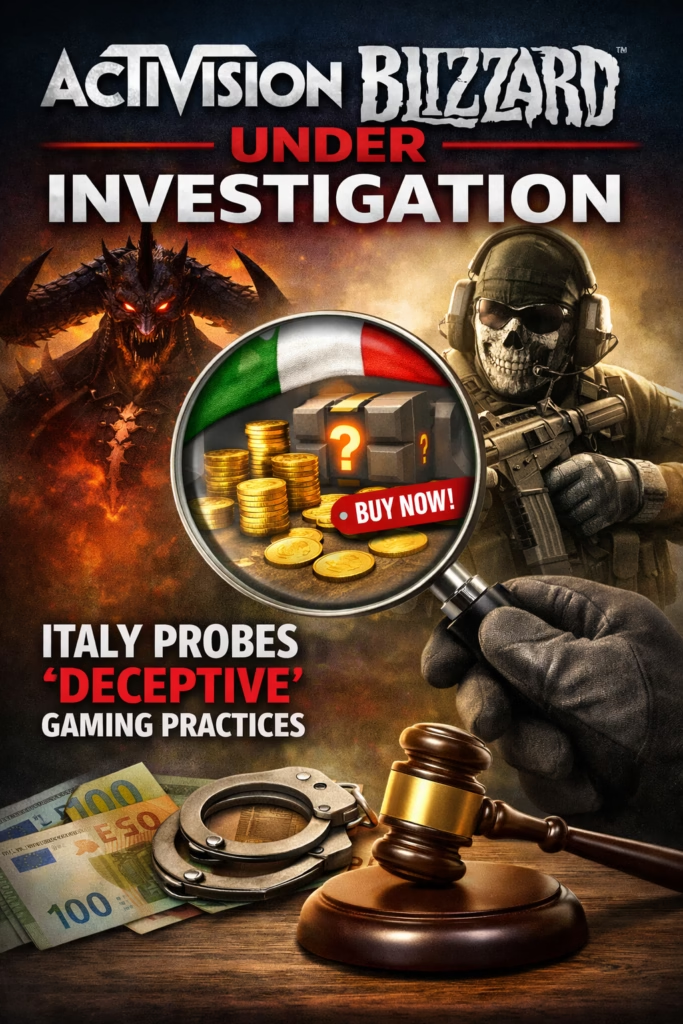

The Italian Competition Authority (AGCM) announced that it has launched two investigations into Activision Blizzard for ‘misleading and aggressive practices’.1 The authority’s investigations concern the video games Diablo Immortal and Call of Duty Mobile. The alleged misleading aggressive practices relate to the games describing themselves as free to play, but offering in-game purchases.2 In a statement, the regulator said: “In the Authority’s view, the company may be acting in breach of consumer protection rules and, in particular, the duty of professional diligence required in a sector that is particularly sensitive to the risks of gaming-related addiction”.3
In its statement, the AGCM explained that the games used:
“deceptive user-interface design aimed at inducing consumers to play more often, extend their gaming sessions and take up promoted offers. Examples include repeated prompts, both during and outside gameplay, urging users not to miss out on rewards – also through in-app messages and push notifications – as well as to purchase time-limited items before they become unavailable”.4
Through these practices, the regulator claims users are unable to understand the real value of the virtual currency used in the games, and may influence players, including minors, to spend significant amounts.5 In that vein, the authority argues the parental control features pre-set in the games offer a low level of protection for minors.6 Other ancillary issues which will be investigated by the authority are how consent for personal data is obtained, and whether consumers are adequately informed about their rights in the games.7
This investigation by the Italian Competition Authority is not the first European regulatory scrutiny faced by Microsoft following its acquisition of Activision Blizzard, as this USD 69 billion acquisition was highly scrutinised by the EU, FTC, and the CMA.8 However, while the past investigations predominantly focused on competition law and market access concerns, the Italian authority’s investigation focuses on consumer protection and commercial conduct.9
EU’s Response to Deceptive Practices
The Italian investigation is part of a current large regulatory trend across the EU in which consumer authorities are turning attention to free-to-play games.10 The main legal instrument relied upon by regulators in the EU is the Digital Services Act, particularly article 25(1), which states: “Providers of online platforms shall not design, organise or operate their online interfaces in a way that deceives or manipulates the recipients of their service or in a way that otherwise materially distorts or impairs the ability of the recipients of their service to make free and informed decisions”.11
Nevertheless, as previously analysed on Esports Legal News, further deceptive practices regulation, particularly centered around the issue of Loot Boxes, have been a major focus of discussion in the EU. In October 2025, EU MEPs from the Internal Market and Consumer Protection Committee adopted a report urging the European Commission to ban loot boxes, specifically in games accessible to minors.12 Consequently, the EU has proposed the Digital Fairness Act, foreseen for Q4 of 2026, in which a potential introduction is the ban of loot boxes completely, or alternatively, the requirement for game developers to obtain parental consent for loot box purchases by minors.13
The United States v. Cognosphere Parallel
Loot boxes are often central components in ‘free-to-play’ games,14 and this investigation by the Italian authority reflects the exact problems the proposed Digital Fairness Act attempts to solve. A case that comes to mind with regards to deceptive practices and minor protection is United States v. Cognosphere, LLC, Case No. 2:25-cv-00447, where the American FTC reached a settlement and fined Cognosphere (HoYoverse), the developer and publisher of Genshin Impact, USD 20 million for unfairly marketing loot boxes to children, obscuring their real costs, misleading all players about the odds of obtaining prizes, and not screening players’ ages by way of an ‘age gate’.15
The FTC stated that the loot boxes amounted to such unfair practices, causing substantial injury to consumers by deceiving children into “spending hundreds of dollars on prizes they stood little chance of winning“.16 The FTC’s decision set an important precedent for the enforcement of loot boxes in the US, and served as a warning for game developers, with the FTC explicitly stating: “the gaming industry should be on notice that wanton use of loot boxes may create exposure to multiple theories of liability. Children may be unable to assess low-probability events, but responsible video-game publishers would be well advised not to take the chance of getting themselves hooked on loot boxes”.17
While the Cognosphere case occurred in the US, given the EU’s push for extra minor protection and regulation of ‘free-to-play’ games, it would be unsurprising if the Italian Competition Authority reaches a similar decision with its Activision Blizzard investigation, seeking to deter any game developers from similar practices in future games.
If the AGCM issues a fine against Activision Blizzard, the author expects it to be substantial, as the company has been earning significant amounts of money from its mobile games, even more than its PC and console games combined.18 According to Article 27-bis(2-bis) of the Italian Consumer Code, a fine imposed on traders responsible for widespread (union-wide) infringements can be as high (but not exceed) as 4% of the trader’s annual revenue in Italy.19 Given that in 2020 consumers in Italy spent EUR 2.18 Billion in the gaming industry,20 it can be assumed Activision Blizzard’s annual turnover in Italy is substantial.
Takeaways
Overall, the author believes this investigation may help solve an important problem in the video game industry: ‘free-to-play’ games are never truly free. As put brilliantly by Bitdefender’s Cristina Popov: “Nothing in life is truly free… many of these “free” apps come with hidden costs. Some collect personal data, others bombard kids with ads, and many encourage spending through in-app purchases. Behind the fun and engaging gameplay, these apps often prioritize profit over privacy and safety, leaving children vulnerable to risks parents might not see at first glance”.21
Similarly to FTC’s Cognosphere case, this investigation by the Italian Competition Authority, especially against Activision Blizzard, which was acquired by the giant Microsoft, can establish a very important precedent in the EU’s battle against deceptive and unfair practices in video games, specifically those leaving children vulnerable.
- PYMNTS, ‘Italian Competition Authority Investigates Activision Blizzard’s Promotions and Parental Controls’ (PYMNTS, 16 January 2026) https://www.pymnts.com/legal/2026/italian-competition-authority-investigates-activision-blizzards-promotions-and-parental-controls/ accessed 20 January 2026.
↩︎ - AGCM, ‘The Italian Competition Authority launches two investigations into gaming company Activision Blizzard (Microsoft group)’ (Press Release PS13020-PS13039, 16 January 2026) https://en.agcm.it/en/media/press-releases/2026/1/PS13020-PS13039 accessed 20 January 2026.
↩︎ - ibid. ↩︎
- ibid. ↩︎
- ibid. ↩︎
- ibid. ↩︎
- Alex Forbes-Calvin, ‘Italian Competition Authority Investigating Activision Blizzard over Diablo Immortal and Call of Duty Mobile Monetisation’ (GamesIndustry.biz, 16 January 2026) https://www.gamesindustry.biz/italian-competition-authority-investigating-activision-blizzard-over-diablo-immortal-and-call-of-duty-mobile-monetisation accessed 21 January 2026.
↩︎ - Elena Rodriguez, ‘Italian Regulator Opens Probes into Activision Blizzard Mobile Sales Practices’ (Prism News, 16 January 2026) https://www.prismnews.com/news/italian-regulator-opens-probes-into-activision-blizzard-mobile-sales-practices accessed 21 January 2026.
↩︎ - ibid. ↩︎
- ibid. ↩︎
- Cyber Risk GmbH, ‘Article 25, Online interface design and organisation – the Digital Services Act (DSA)’ https://www.eu-digital-services-act.com/Digital_Services_Act_Article_25.html accessed 21 January 2026.
↩︎ - European Parliament, ‘New EU measures needed to make online services safer for minors’ (16 October 2025) https://www.europarl.europa.eu/news/en/press-room/20251013IPR30892/new-eu-measures-needed-to-make-online-services-safer-for-minors accessed 20 January 2026.
↩︎ - ibid. ↩︎
- Kris Holt, ‘Italian regulators are investigating Activision Blizzard’s monetization practices’ (Engadget, 16 January 2026) https://www.engadget.com/gaming/italian-regulators-are-investigating-activision-blizzards-monetization-practices-135057481.html accessed 21 January 2026.
↩︎ - Stacy Feuer, ‘A Kids’ Privacy Adventure: Exploring the FTC’s Privacy and Lootbox case against Genshin Impact’ (24 January 2025) https://www.esrb.org/privacy-certified-blog/a-kids-privacy-adventure-exploring-the-ftcs-privacy-and-lootbox-case-against-genshin-impact/ accessed 21 January 2026.
↩︎ - Matt Kim, ‘Genshin Impact Developer Agrees to $20M Fine Over Loot Box Violations’ (17 January 2025) https://www.ign.com/articles/genshin-impact-developer-agrees-to-20m-fine-over-loot-box-violations accessed 21 January 2026.
↩︎ - Rebecca Kelly Slaughter, ‘Concurring Statement of Commissioner Rebecca Kelly Slaughter Regarding United States v. Cognosphere, LLC’ (17 January 2025) https://www.ftc.gov/system/files/ftc_gov/pdf/slaughter-cognosphere-statement.pdf accessed 21 January 2026.
↩︎ - Charlie Kelly, ‘Activision Blizzard investigated by Italian regulator over mobile game microtransactions’ (Checkpoint Gaming, 16 January 2026) https://checkpointgaming.net/news/2026/01/activision-blizzard-investigated-by-italian-regulator-over-mobile-game-microtransactions/ accessed 20 January 2026.
↩︎ - Bird & Bird, ‘Omnibus Directive: Italy’ https://www.twobirds.com/en/trending-topics/omnibus-directive/omnibus-directive-countries/italy accessed 21 January 2026.
↩︎ - James Batchelor, ‘Games spending passes €2bn but audience has shrunk | Italy Annual Report’ (GamesIndustry.biz, 13 April 2021) https://www.gamesindustry.biz/games-spending-passes-2bn-but-audience-has-shrunk-italy-annual-report accessed 21 January 2026.
↩︎ - Cristina Popov, ‘The Hidden Dangers of Free Apps and Games for Kids’ (Bitdefender, 8 April 2025) https://www.bitdefender.com/en-us/blog/hotforsecurity/the-hidden-dangers-of-free-apps-and-games-for-kids accessed 21 January 2026.
↩︎