Labor&Immigration
The Industry at a Breaking Point: Key Takeaways from the GDC 2026 State of the Game Industry Report
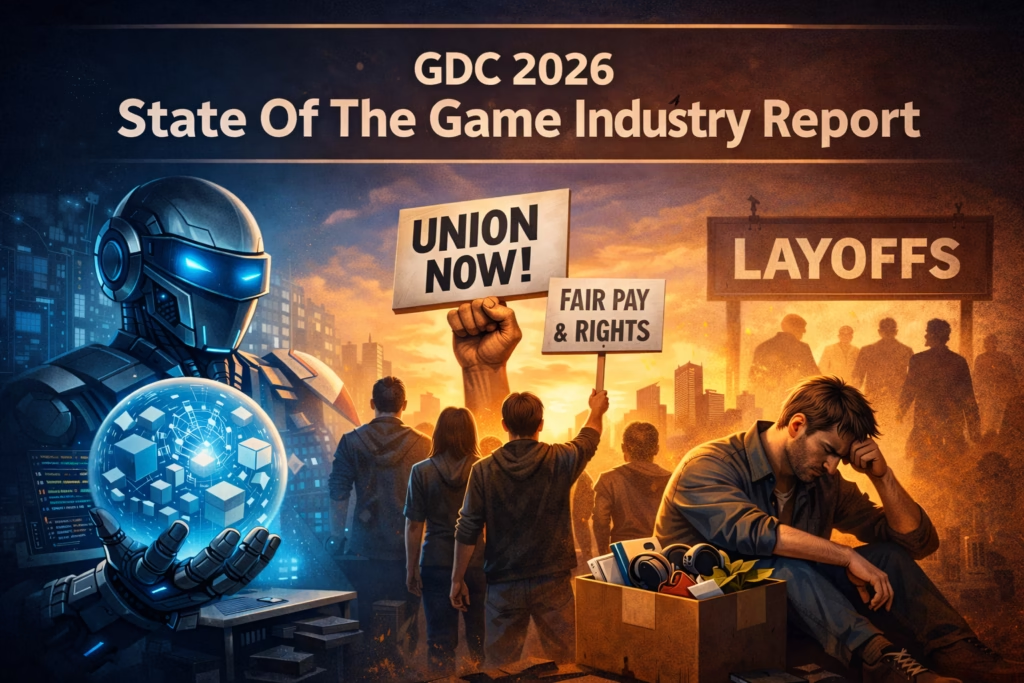

The GDC Festival of Gaming, previously known as the Game Developers Conference, has recently published its 2026 State Of The Game Industry Report. The report was compiled based on a survey completed by 2,300 industry professionals, with 62% of respondents working at game companies or studios, with that number distributing into 45% working at independent studios, 31% at AAA studios (major studios working with significant product and marketing budgets, known for high profile games),1 18% at AA studios (studios working with smaller budgets, yet still often working with large groups of people),2 and 6% at co-development studios (small teams helping out other studios with their projects, most often with art and animation).3
The number of respondents saw a 23% drop Year-over-Year, which can be attributed to the event’s launching later than usual, and the event’s rebrand, which has proved controversial.4 The event has been met with some criticism from industry professionals.
For example, Brian Baglow, founder and director of the Scottish Games Network, has complained that the event is too focused on the opinions of those working in the gaming industry, and lacks the perspectives of other stakeholders: “Where are the players, the communities, the educators and academics? We’re the largest creative industry in the world and we’re still locked inside a silo of our own making. We need the film, TV, music, and wider world to be a part of this. I think it’s a missed opportunity“.5
Nevertheless, the report can still help us draw an important picture of the current state of the gaming industry, and there are several crucial takeaways we must pay attention to in order to stabilise this volatile and dynamic market, and ensure a fruitful and prospering industry.
The Layoff Epidemic
One of the most significant issues that the report has identified in the gaming industry is the layoff rate. The report showed that over the last two years, 28% of respondents experienced a layoff.6 That number was even higher for developers within the United States, reaching 33% of respondents.7 Over the last year, 17% of respondents stated they had been laid off.8 Of those laid off, 48%, almost half of the respondents, said they were still looking for employment.9
Over 450 respondents reported that their companies experienced acquisitions, closures, or mergers. The report explained that “AAA and older indie respondents were more likely to report their companies were acquired, and newer indie studios were more likely to close”.10 Employees at AAA studios were more likely to have encountered layoffs, with two-thirds claiming to have experienced them.11 Regarding the reason for the layoffs, 43% of respondents cited company restructuring, 32% cited project cancellations, and 38% cited budget cuts and market conditions.12
The role that reported the highest percentage of layoffs over the last year were game designers, with 20% of those surveyed affected.13 The author believes this statistic is in line with the rise in Generative AI (GenAI) use, analysed on Esports Legal News, with controversies like the Black Ops 7 GenAI shining light on the risks presented to job security. Indeed, one of the report respondents was quoted stating: “Now, money is a lot tighter because the goldfish with the money want returns yesterday so they can funnel it into the current fad (genAI)“.14
When asked about overall sentiment regarding layoffs, over half of respondents expressed a negative or neutral expectation for whether they anticipate layoffs at their company in the next year.15 Those most worried are the students and those in junior positions, with 74% who responded expressing concerns about their future job prospects.16
The report thus suggests that the pressing issue of job instability remains at the forefront of the gaming industry, and it is seemingly getting worse. The author believes that acquisitions, such as of Electronic Arts, and the rising use of GenAI, as demonstrated via the Black Ops 7 controversy, will only worsen the situation in the market.
Hence, the report highlights the need for action to be taken to ensure employees in the gaming industry are protected. Such action can be the drafting of specific regulation, as recommended by Rep. Ro Khanna (D-Calif.), who said: “We need regulations that prevent companies from using AI to eliminate jobs to extract greater profits. Artists at these companies need to have a say in how AI is deployed. They should share in the profits. And there should be a tax on mass displacement”.17 Another potential action is for unionisation in the gaming industry.
The Rise of “Protest Unionisation”
Seemingly in response to the consistent negative sentiments around job instability in the gaming industry, the report explored the unionisation interest amongst the respondents. Due to differing international legislation, the survey only asked respondents based in the US about whether they support unionisation for game industry workers. The results echoed a resounding ‘yes’: 82% supported unionisation, 13% unsure, and only 5% opposing it.18
The distribution of the responses is telling, as not a single 18- to 24-year old was opposed to unionisation. Other groups with significant support for unionisation are employees earning under $200,000 a year (87%), employees who have been laid off during the past 24 months (88%), and employees under 45 years old (86%).19
The survey also asked, for the first time ever, whether the respondents are members of a union: a staggering 62% of respondents replied that they were not in a union but were interested in joining one, and only 12% responded that they are either in a company-specific, or an industry-wide union.20 It is thus clear to see that the gaming industry still lacks effective unionisation, despite the apparent demand.
Although the survey only concerned US respondents regarding unionisation, past industry controversies have demonstrated that industry professionals in other jurisdictions may share a similar sentiment towards the lack of unionisation. For example, just recently a legal dispute has arisen following the sudden firing of over 30 employees by Rockstar Games, with the majority based in Edinburgh, at Rockstar North. The employees alleged union busting, whereas Rockstar claims the employees discussed things contrary to company policy on Discord. This situation will now be taken to Tribunal for a hearing.21
As analysed recently on Esports Legal News, the author argues that the gaming industry could benefit greatly from unionisation. The job instability, as the GDC’s report demonstrates, alongside volatile working conditions, with the ‘crunch’ culture at its forefront (periods of intense, often mandatory overtime work to meet deadlines),22 could be potentially mitigated through collective bargaining agreements and stronger employee protections.
Especially in the esports market, the author urges for the creation of a stable, unified labour model: a framework that structurally resembles the power and legal recognition of FIFPro (the worldwide representative for professional football players, promoting the interests of professional female and male players),23 but one which is specifically built to address the often exploitative publisher-owner dynamic.
Generative AI: Adoption vs. Backlash
Another increasingly relevant topic that was analysed in the GDC’s report is the reception to Generative AI (GenAI) in the gaming industry. 36% of respondents stated they use AI in their work, however the percentage varied quite significantly by job discipline.24 Business professionals reported the highest usage at 58%, joined by support teams and PR firms. Game studio employees reported nearly 30% less AI usage than the former, alongside employees in junior positions, of which only 29% reported AI usage.25
Regarding how AI is employed, 81% of respondents using AI stated they use it for research purposes, followed by a significant drop to 47% for code assistance, 22% for testing and debugging, to only 5% for player-facing features.26
Interestingly, the majority of respondents’ sentiment regarding GenAI is not positive, with 52% saying they felt GenAI had a negative impact on the game industry.27 This statistic is very telling, as the number has steadily increased per year, from 18% of respondents in 2024 and 30% in 2025,28 i.e. the percent of industry professionals believing GenAI is detrimental to the gaming industry has nearly tripled in three years. The reasons cited for the opposition were data sourcing, energy consumption, and predictably, the risk of AI replacing jobs.29
The more specific distribution of respondents expressing a negative sentiment is as such: 64% of workers in visual and technical arts, 63% of workers in game design and narrative, and 59% of workers in game programming.30 Only 7% of all respondents said that GenAI was having a positive impact on the game industry, out of which, the support was highest amongst executives and those in business operations and services.31
This data shows, on one hand, how strongly opposed those in creative and technical roles are to the use of GenAI in the gaming industry, while on the other hand, support remains concentrated among those who prioritise the tools’ potential for operational efficiency and cost reduction. Sources report that AI-driven game development has reduced production costs by 20-30%,32 yet the production personnel are seemingly unhappy, as demonstrated by the report.
In an interview with Bradley, an artist working at an AAA game studio, he explained that in his interview with the studio he was assured he wouldn’t have to work with GenAI, however that turned out to be false, claiming that “his boss will just keep prompting an AI for images until he finds one he likes, and then the art team will have to backwards engineer the whole thing to make it work”.33
Thus, the author believes that executives must reflect whether the added efficiency of the use of AI in game development is worth the added regulatory compliance and potential public and internal employee backlash.
Takeaways
The gaming industry is, in the author’s view, in the midst of some very pivotal years. On one hand, we are seeing the move to new hardware and AI tools that could streamline efficiency and potentially even improve some aspects of games. On the other hand, as the GDC report suggests, job instability and negative sentiments towards the use of GenAI in game development are plaguing the industry, and demotivating those who shape it.
This report saw significant changes in sentiment from the previous two years’ responses, and if no action is taken, the gaming industry could foreseeably continue going down a dangerous path, dominated by employee dissatisfaction. To deal with the job instability issue, the author calls for regulators to intervene, and for the creation of a unionisation model, similar to FIFPro. As for the GenAI usage, it is important for those in charge of studios to reflect on the responses in the GDC’s report: is the added benefit GenAI gives truly worth the demotivation and dissatisfaction of your employees?
- Gameopedia, ‘AAA Games: A Comprehensive Guide’ (Gameopedia, 2024) https://gameopedia.com/blogs/aaa-games-a-comprehensive-guide accessed 29 January 2026.
↩︎ - Gameopedia, ‘Indie, AAA, and AA Games: A Comparison’ (Gameopedia, 2024) https://gameopedia.com/blogs/indie-aaa-and-aa-games-a-comparison accessed 29 January 2026.
↩︎ - How co-development companies are navigating a turbulent industry in 2025, GamesIndustry.biz (website post, 2025) https://www.gamesindustry.biz/how-co-development-companies-are-navigating-a-turbulent-industry-in-2025 accessed 30 January 2026.
↩︎ - GDC survey reveals layoffs up 6%, 36% of industry using AI, and overwhelming support for unionisation in the US, GamesIndustry.biz (website post, 2026) https://bit.ly/4rmq1K6 accessed 30 January 2026.
↩︎ - GamesIndustry.biz, GDC Festival of Gaming: The industry reacts to the controversial rebrand (online, 28 October 2025) https://www.gamesindustry.biz/gdc-festival-of-gaming-the-industry-reacts-to-the-controversial-rebrand accessed 30 January 2026.
↩︎ - GamesIndustry.biz, (n. 4).
↩︎ - Eurogamer, One third of surveyed US games industry workers were laid off in the last two years, GDC reports (online, 30 January 2026) https://www.eurogamer.net/one-third-of-surveyed-us-games-industry-workers-were-laid-off-in-the-last-two-years-gdc-reports accessed 29 January 2026.
↩︎ - ibid.
↩︎ - ibid.
↩︎ - ibid.
↩︎ - GamesIndustry.biz, (n 4).
↩︎ - Eurogamer, (n 7).
↩︎ - Eurogamer, (n 7).
↩︎ - Eurogamer, (n 7).
↩︎ - GamesIndustry.biz, (n. 4).
↩︎ - GamesIndustry.biz, (n. 4).
↩︎ - Connor Makar, ‘Even members of the US Congress are pushing back against Call of Duty: Black Ops 7’s AI use’ (17 November 2025) https://www.eurogamer.net/even-members-of-the-us-congress-are-pushing-back-against-call-of-duty-black-ops-7s-ai-use accessed 29 January 2026.
↩︎ - GamesIndustry.biz, (n. 4).
↩︎ - GamesIndustry.biz, (n. 4).
↩︎ - GamesIndustry.biz, (n. 4).
↩︎ - Institute of Employment Rights (IER), Rockstar Games workers denied interim relief as union-busting case goes to tribunal (online, 23 January 2026) https://www.ier.org.uk/news/rockstar-games-workers-denied-interim-relief-as-union-busting-case-goes-to-tribunal/ accessed 29 January 2026.
↩︎ - Matthaios Tsimitakis, ‘Crunch in the Gaming Industry: A Persistent Crisis in The Digital Playground’ (Creatives Unite, 24 January 2025) https://creativesunite.eu/article/crunch-in-the-gaming-industry-a-persistent-crisis-in-the-digital-playground accessed 30 January 2026.
↩︎ - ČAFH, ‘About FIFPro’ (2025) https://cafh.cz/en/more-about-fifpro accessed 30 January 2026.
↩︎ - GamesIndustry.biz, (n. 4).
↩︎ - GamesIndustry.biz, (n. 4).
↩︎ - GamesIndustry.biz, (n. 4).
↩︎ - GamingOnLinux, GDC 2026 report – 36% of devs use generative AI, while 28% target Steam Deck and 8% Linux (online, 30 January 2026) https://www.gamingonlinux.com/2026/01/gdc-2026-report-36pct-of-devs-use-genai-28pct-target-steam-deck-and-8pct-target-linux/ accessed 30 January 2026.
↩︎ - GamesIndustry.biz, (n. 4).
↩︎ - GamesIndustry.biz, (n. 4).
↩︎ - GamesIndustry.biz, (n. 4).
↩︎ - GamesIndustry.biz, (n. 4).
↩︎ - PatentPC, The state of AI in the gaming industry: Market growth and revenue stats (online, 2026) https://patentpc.com/blog/the-state-of-ai-in-the-gaming-industry-market-growth-and-revenue-stats accessed 30 January 2026.
↩︎ - Luke Plunkett, ‘An Overwhelmingly Negative and Demoralizing Force: What It’s Like Working for a Company That’s Forcing AI on Its Developers* (Aftermath, 7 April 2025) https://aftermath.site/ai-video-game-development-art-vibe-coding-midjourney/ accessed 30 January 2026.
↩︎