Compliance & Regulatory
New York vs. Valve: The Loot Box Lawsuit That Could End the Skin Market

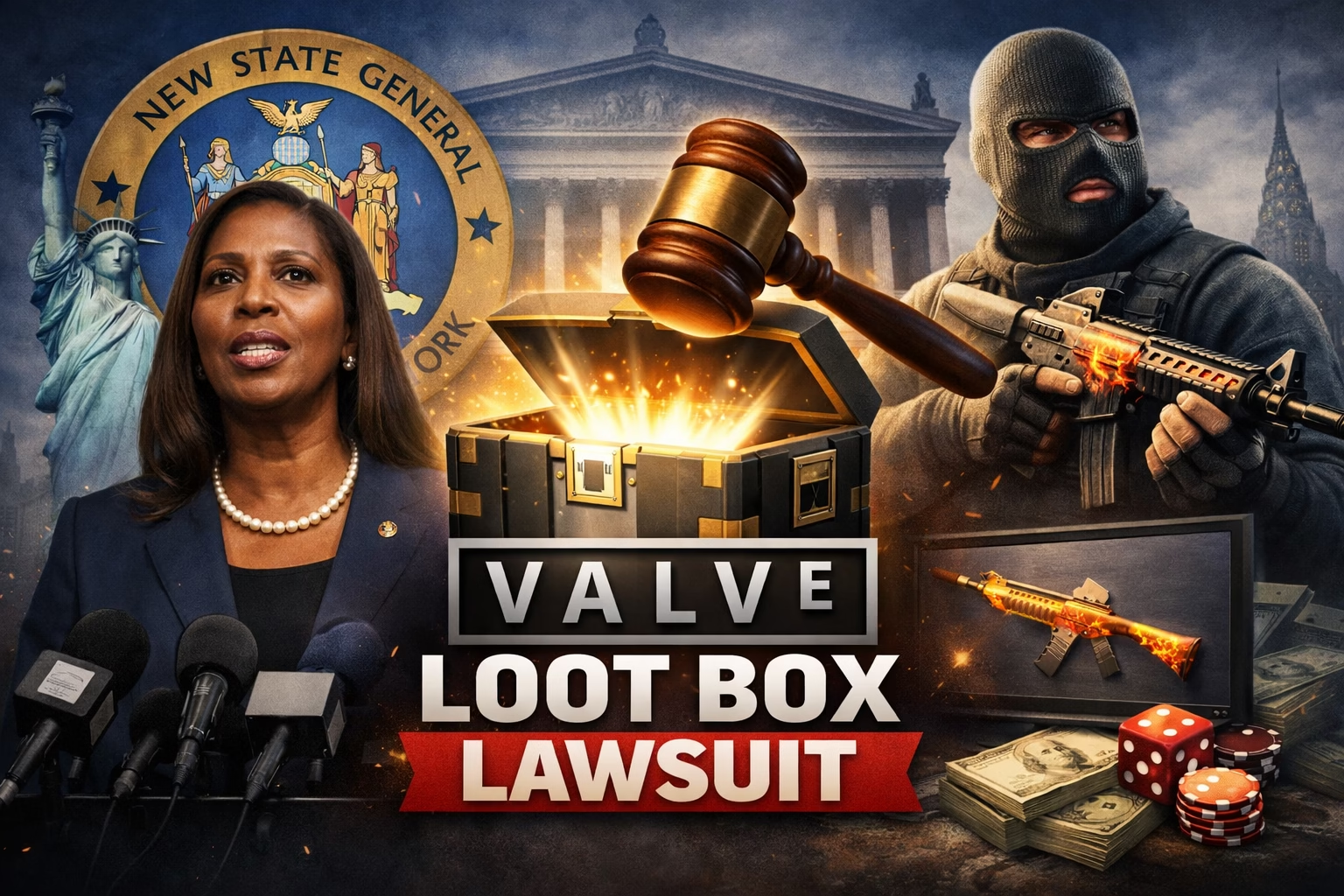

Table of Contents
The “Online Casino” Allegation: Valve Faces Landmark New York Gambling Lawsuit
In what could prove to be a groundbreaking move for the gaming industry, Letitia James, New York’s Attorney General, sued Valve, a video game developer with titles such as Counter-Strike and Dota, for promoting illegal gambling and threatening to addict children through its use of “loot boxes”.1
Letitia James announced the complaint in a press release, which states that following an investigation, the office of the attorney general “found that Valve’s video games… enable gambling by enticing users to pay for the chance to win a rare virtual item of significant monetary value“.2 With the complaint, the Attorney General is seeking to permanently stop Valve from continuing the promotion of illegal gambling in its games and to pay disgorgement and fines.3
The Attorney General alleges that young users with limited funds are especially at risk, as they can be enticed to start gambling through loot boxes in the hopes of obtaining items which could enhance their status in the games’ virtual worlds.4 In that regard, she also mentioned that teenage boys make up the core audience for first-person shooter games like Counter-Strike, and the fact that many top esports players are under 18, thus demonstrating that this age group is particularly exposed to the alleged harm.5
James stated: “The franchises also have proven to be remarkably lucrative for Valve, even though the games have been free to play for years. Valve has managed this feat by pioneering an alternative model for monetising its games: gambling“.6 James cited an example of a ‘skin’ for a gun on Counter-Strike selling for over USD 1 Million in 2024, and the overall Counter-Strike ‘skin’ market being worth over USD 4.3 Billion in March 2025.7
The Attorney General alleges that the billions of dollars made by Valve through loot boxes were made by “luring its users, many of whom are teenagers or younger, to engage in gambling in the hopes of winning expensive virtual items that they can cash in on”.8 The money generated through these loot boxes has even attracted speculators and investors, who identified these virtual items as potentially lucrative digital assets.9
James filed a complaint in a Manhattan state court, in which she argued that Valve’s loot boxes amounted to ‘quintessential gambling’ due to valuable items being hard to win and a large amount of items which are worth close to nothing.10 Specifically, she stated: “This loot box model that Valve has developed—charging an individual for a chance to win something of value based on luck alone—is quintessential gambling, prohibited under New York’s Constitution and Penal Law”.11 The specific violations cited in the lawsuit are Article I, Section 9 of the New York Constitution, which prohibits gambling (bar some exceptions), and Penal Law §§ 225.05 and 225.10, which criminalise promoting gambling.12
In the complaint, it is mentioned that in Valve’s Counter-Strike 2, the loot box opening process resembled a slot machine, with an animated spinning wheel that ultimately stops on a selected item.13 In that regard, James went as far as saying that since the prizes in the loot boxes are randomly determined based on odds set by Valve themselves (with valuable items much rarer to get), it effectively makes Valve an online casino.14
On top of that, the investigation made by the state alleges that Valve also fails to properly verify user age for its games and the loot boxes, as although they prohibit accounts for children under 13, users simply need to click a checkbox to ‘confirm’ they meet this threshold.15
Outside the formal complaint, James voiced her concerns on social media, releasing a powerful statement:
“Valve, a video game developer, has made billions of dollars by letting children and adults illegally gamble for the chance to win valuable virtual prizes … These features are addictive and harmful. That’s why I’m suing to stop Valve’s unlawful conduct and protect New Yorkers“.16
James also remarked that Valve allows users to either sell their items through their own internal marketplace, where they can use the proceeds to buy other things on the Steam Community Market, or, users can also connect their Valve accounts to third-party marketplaces where they can sell their items directly for cash.17 According to the Attorney General’s investigation, Valve often facilitates and even assists these third-party marketplaces.18 In these third-party marketplaces, users are often complaining of online account hacks, or even being tricked by ‘bad actors’ into transferring rare items.19
On top of the gambling concerns, the Attorney General also asserted that Valve’s promotion of games that glorify violence and guns are particularly problematic among young users, who can become numbed to violence before their brains fully develop.20
Valve itself has historically consistently denied that its loot boxes violate gambling law, and has claimed that they are taking action against third-party marketplaces selling items for its games.21 Valve have previously faced a similar investigation with the Danish Gambling Authority, where they explained that enforcing the third-party marketplaces is “a game of cat and mouse” as users transfer items via ‘gifting’ (which is allowed) while transferring payment via PayPal, outside the system.22
Possible Implications and Takeaways
The current investigation could be very impactful for the gaming industry. As discussed previously on Esports Legal News, jurisdictions adopt different approaches to regulating loot boxes, however those often fall short of achieving anything meaningful.
For example, in the UK, which has taken a ‘self-regulatory’ approach overseen by UK Interactive Entertainment, less than 10% of social media ads for video games with loot boxes disclosed the presence of those loot boxes as required.23
However, these jurisdictions, such as the UK, seem to be running out of patience when it comes to this lack of transparency. On February 26th, 2026, the UK Advertising Standards Authority took a firmer stance by issuing an Enforcement Notice regarding the disclosure of loot boxes in mobile game advertising and app store listing, mandating the disclosure of the presence of random-item purchases at ‘the point of download’.24 This notice in the UK, alongside the litigation in New York, suggests a global movement is forming against traditional loot boxes in games.
Where the UK seeks transparency, the actions taken by Letitia James in New York aim for a more fundamental transformation. James’ lawsuit could firmly establish the tidal shift many have long anticipated, as she is seeking not just disclosure, but full restitution to consumers, an extremely significant fine, and a permanent ban on the gambling features present in Valve’s loot boxes within New York. If successful, this litigation might signal the end of the industry’s reliance on the ‘skin economy’, currently valued in the billions.
Moreover, this investigation could lead to game developers strengthening their consumer protection, specifically children protection measures. This extends both to loot boxes and gambling or gambling-like features, but also generally to games where children are a predominant demographic. This is crucial as children are often very vulnerable in video games, as was recently seen with the Roblox saga in Australia, and thus developers must be forced to protect them.
In the last year, the US has seen a few crucial cases relating to the regulation of loot boxes. For example, in January 2025, the Federal Trade Commission fined Cognosphere, the creator of Genshin Impact, USD 20 Million for violating children’s privacy laws and misleading consumers about loot box odds, on top of a requirement for parental consent for players under 16 and a clear disclosure of real-money costs and odds.25 The current Valve investigation, if successful, will represent another key moment in the battle against loot boxes, and would likely lead to a ripple effect where other states may start taking actions similar to New York.26
Overall, this is an important moment for the gaming industry, as it exposes the strategies employed by game developers to abuse their users’ vulnerabilities, and the psychological and economic risks inherent in randomised rewards, such as loot boxes, which are so heavily used nowadays in the industry. The author hopes New York prevails in this litigation, as a victory would prioritise the safety of consumers, and most importantly, children, who are increasingly placed in vulnerable positions in the gaming industry. The author believes that protecting the next generation from risks such as early gambling addiction is a necessity that far outweighs the protection of the enormous ‘skin economy’.
- Jonathan Stempel and Bill Berkrot, ‘New York sues video game developer Valve, says its “loot boxes” are gambling’ (Reuters, 25 February 2026) https://www.reuters.com/legal/government/new-york-sues-video-game-developer-valve-says-its-loot-boxes-are-gambling-2026-02-25/ accessed 3 March 2026.
↩︎ - Rebekah Valentine, ‘New York Attorney General Sues Valve, Alleging Its Loot Boxes Illegally Promote Gambling’ (IGN, 26 February 2026) https://www.ign.com/articles/new-york-attorney-general-sues-valve-alleging-its-loot-boxes-illegally-promote-gambling accessed 3 March 2026.
↩︎ - ibid.
↩︎ - Gaming Intelligence, ‘New York AG sues Valve for promoting illegal gambling via video games’ (26 February 2026) https://www.gamingintelligence.com/legal/226948-new-york-ag-sues-valve-for-promoting-illegal-gambling-via-video-games/ accessed 4 March 2026.
↩︎ - Andrew O’Malley, ‘New York AG Sues Valve, Says Loot Boxes Generated Billions Through Illegal Gambling’ (Gambling Insider, 26 February 2026) https://www.gamblinginsider.com/news/114563/new-york-ag-sues-valve-loot-box-illegal-gambling accessed 5 March 2026.
↩︎ - Jesse Zanger, ‘New York AG Letitia James sues video game giant Valve over “loot boxes,” calling them “quintessential gambling”’ (CBS New York, 25 February 2026) https://www.cbsnews.com/newyork/news/new-york-ag-letitia-james-sues-valve-loot-boxes-gambling/ accessed 4 March 2026.
↩︎ - ibid.
↩︎ - Rebekah Valentine, (n 2).
↩︎ - Gaming Intelligence, (n 4).
↩︎ - Jonathan Stempel and Bill Berkrot, (n 1).
↩︎ - Jesse Zanger, (n 6).
↩︎ - Andrew O’Malley, (n 5).
↩︎ - Rebekah Valentine, (n 2).
↩︎ - Jesse Zanger, (n 6).
↩︎ - Andrew O’Malley, (n 5).
↩︎ - Jesse Zanger, (n 6).
↩︎ - Gaming Intelligence, (n 4).
↩︎ - Gaming Intelligence, (n 4).
↩︎ - Jesse Zanger, (n 6).
↩︎ - Gaming Intelligence, (n 4).
↩︎ - Andrew O’Malley, (n 5).
↩︎ - Andrew O’Malley, (n 5).
↩︎ - Leon Y. Xiao, ‘UK video game industry fails to self-regulate gambling-like loot boxes’ (11 June 2025) https://royalsociety.org/blog/2025/06/video-game-industry-loot-boxes/ accessed 4 March 2026.
↩︎ - Advertising Standards Authority, ‘Enforcement Notice: Disclosure of loot boxes in app stores’ (26 February 2026) https://www.asa.org.uk/static/49fcb813-4d44-44ed-9bdb37d63ae40863/eeaa3db7-45d4-4641-9afecc48b2aae02a/Enforcement-Notice-Disclosure-of-loot-boxes-in-app-stores.pdf accessed 4 March.
↩︎ - Andrew O’Malley, (n 5).
↩︎ - Andrew O’Malley, (n 5).
↩︎