Competition
From FIFA to Warner Bros: Evaluating Netflix’s Gaming Expansion Under Antitrust and Consumer Disclosure Standards
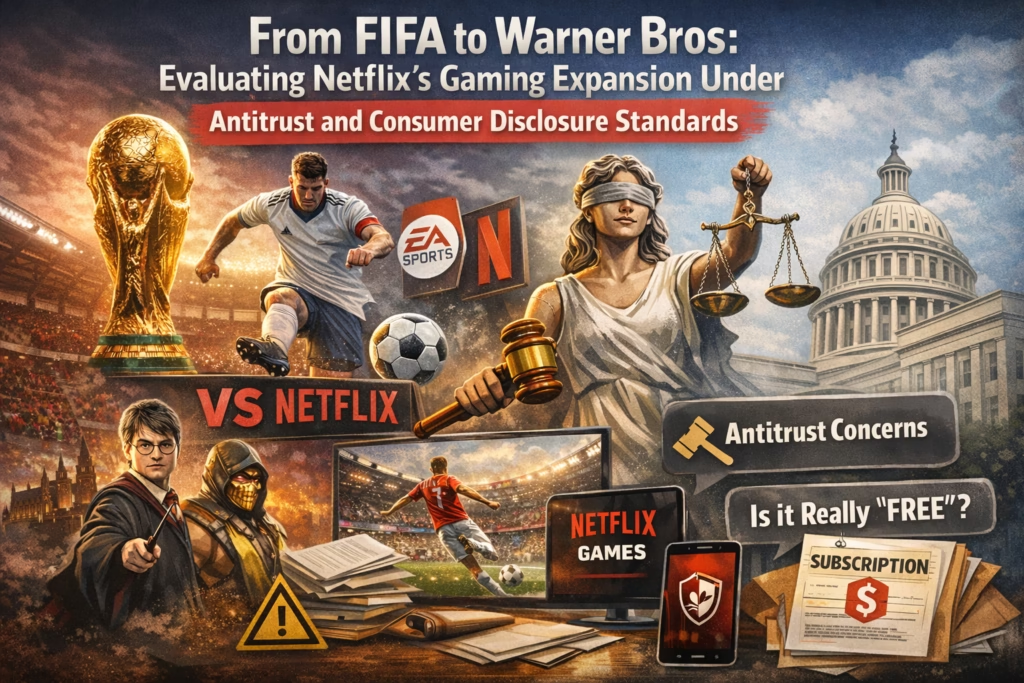

In December 2025, Netflix announced that they are partnering with FIFA (Fédération Internationale de Football Association) for a 2026 World Cup game, expected to launch in the summer of 2026, just in time for the long-awaited football tournament.1 The game will be developed and published by Delphi Interactive and will be available to play on the Netflix platform as single-player or online.2 All the game requires in order to be played is a Netflix account and a phone. Users could either play on the Netflix app on iOS or Android devices, or on their TVs by using their phones as controllers.3
Why EA and FIFA Split
With this partnership, FIFA is making its long-awaited return into the video game scene, after ending a nearly 30-year partnership with Electronic Arts (EA) in 2022. There were several reported reasons given for this historic split, namely that FIFA believed that the license to use their name carried a value of at least double the USD 150 million that EA previously paid, and that EA were unhappy with FIFA’s attempt to allow other video games and digital products to use its name.
The friendship between the two entities seemingly did not end amicably, demonstrated via a statement given by Peter Moore, a former head of EA’s sports division: “We have literally spent hundreds of millions of dollars building this and you’re telling me that Epic Games can come in and get a license to the name that we have built and that we have put front and center and that has become synonymous with games?”.4 Nevertheless, the split has not hurt EA’s sales, as their renamed game still proved successful, with EA FC 24 being the best-selling game in the UK in 2023.5
Netflix’s Gaming Ambition
The FIFA deal seems to be another piece in Netflix’s puzzle to aggressively expand into the gaming sector. Over recent months, Netflix has not been shy in showing it intends to be a legitimate player in the gaming industry, adding WWE 2K and Grand Theft Auto to its Netflix Games service.6 The Wall Street Journal reported that Netflix is estimated to have invested around USD 1 Billion buying game studios and building its video game business.7
Analysts suggested that this new video game venture by Netflix is in response to a potential decrease in subscribers and the fading of growth.8 The platform hopes that by offering video games, users will keep coming back even when their favorite shows are between seasons.9 However, the analysts note that so far, the video game venture has “struggled amid shifts in leadership and strategy”.10
Brian Mulberry, senior portfolio manager at Zacks Investment Management, commented on Netflix’s business plan, stating: “We understand why they’re taking these measures to have diverse streams of revenue but in the short term, they are not profitable segments”.11 Rob Gallagher, an Omdia analyst, commented that video games do not fit nicely into Netflix’s offerings, because “most subscribers come for a passive, lean-back viewing experience”.12
Nevertheless, Netflix’s moves certainly show commitment to the gaming industry. Potentially Netflix’s most significant recent move has been the purchase of Warner Bros’ gaming studios, who have made incredibly popular titles such as “Mortal Kombat” and “Hogwarts Legacy”,13 which is among the best-selling games of all time.14 This provides Netflix entry into the big-budget games market, which is a significant shift from its offering thus far, which primarily included mobile games and artistic indie games.15
The Legal Critique
Netflix’s venture into video games is certainly an interesting development for the gaming industry, but upon a close examination, a few legal issues may arise. Firstly, Netflix’s goal with the venture, as discussed previously, is to ensure subscription retention. What this means is that their games are likely to remain on their platform only. For example, while Hogwarts Legacy was previously available to play on PlayStation, Xbox, and PC, Netflix’s acquisition of Warner Bros’ gaming studios may mean they will make the title, or any future titles, Netflix exclusive. The author believes this has potential to amount to an input vertical foreclosure, in breach of Competition law.
An input vertical foreclosure is a situation in which a firm who owns an essential input (such as the FIFA licence or the Harry Potter franchise) denies it or makes its access more expensive to an independent firm making use of it.16 When Netflix acquires the ‘inputs’, it can choose to deny those inputs to rival platforms like Sony Playstation or Microsoft Xbox. By withholding these necessary inputs, as franchises like Harry Potter cannot be easily replicated by rivals, Netflix effectively forces its rivals to spend billions to create a ‘Harry Potter rival’ if it wants to compete.
Vertical foreclosure is prohibited under competition law, amounting to exclusionary abuse. Exclusionary abuse is prohibited under article 102 of the TFEU in the EU and Section 2 of the Sherman Act in the US, and is conduct that is meant to exclude or remove competition from the market. With its acquisition of Warner Bros Discovery, Netflix is already under close monitoring by Competition authorities as a potential streaming monopoly.17 Its venture into the gaming market risks evermore scrutiny into their operations.
A relevant case that could apply to this current Netflix situation is FTC v. Microsoft Corporation, No. 23-15992 (9th Cir. 2025).18 This case concerned Microsoft’s acquisition of Activision Blizzard, and the FTC worried that Microsoft would make Call of Duty exclusive to Xbox, foreclosing Sony Playstation from an essential input (a blockbuster game). The court held that while Microsoft had the ability to foreclose, they had no incentive to do so for a variety of reasons, among which that the game’s success depends on cross-platform play.19 Nevertheless, to ease the concerns of the FTC, Microsoft has signed a binding long-term agreement with Sony to ensure that Call of Duty remains available on their platform as well.20
Although in FTC v Microsoft the court ruled in favor of Microsoft, Netflix may find itself facing similar scrutiny, as games like Hogwarts Legacy can be found to be a similarly essential input to Call of Duty. If a court finds Netflix’s new games ‘indispensable’, competition authorities will be quick to ensure no vertical foreclosure is taking place. If Netflix wants to avoid an antitrust lawsuit, they may want to make a similarly binding promise that titles like Hogwarts Legacy will also be available on other platforms.
Another potential legal issue arises with the FIFA president and Netflix CEO claiming that the game will be playable for ‘free’. However, as explained by IGN’s Vikki Blake, “it’s not entirely clear if this access will be paywalled behind certain subscription tiers”.21 The word ‘free’ is controversial from a legal perspective, often being used as a deceptive pricing trap. Hence, many jurisdictions have specific regulation as to the use of the word.
For example, in the US, the FTC issued a ‘Guide Concerning the Use of the Word ‘Free’” (16 CFR §251.1). In this guide, §251.1(b)(1) states that when using the word ‘free’, “a purchaser has a right to believe that the merchant will not directly and immediately recover, in whole or in part, the cost of the free merchandise or service by marking up the price of the article which must be purchased”.22 What this means is that for the games, such as the upcoming World Cup game, to be ‘free’ with a subscription, that subscription must remain at its regular price.
If Netflix raises its monthly fee coincidentally with the launch of the game, regulators could argue the game is just a bundled cost. As regards Vikki Blake’s remark that Netflix has not made it clear if access to its new games will be paywalled behind subscription tiers, if it turns out her worries were correct, Netflix may be breaching §251.1(c) of the FTC’s guide, which says that when marketing an item as ’free’, all conditions on which the ‘free’ item is contingent “should be set forth clearly and conspicuously at the outset of the offer so as to leave no reasonable probability that the terms of the offer might be misunderstood”.23
Takeaways
Netflix has been active recently in its pursuit of a new venture: video games. Netflix has introduced this business strategy in hopes it will yield higher subscription retention, and might even bring new subscribers to the platform.
Most notably, Netflix acquired Warner Bros’ gaming studios which features household titles like Mortal Kombat and Hogwarts Legacy. Additionally, the company is attempting to capitalise on the upcoming 2026 World Cup tournament with a football game in collaboration with FIFA and Delphi Interactive.
While these are exciting times for Netflix, the author suggests Netflix’s aggressive endeavors in the gaming industry raise a couple of significant potential legal issues: the exclusive FIFA license and essential inputs like the Harry Potter franchise can amount to vertical foreclosure if Netflix decides to make games available exclusively on its platform. This may raise some competition authority eyebrows as potential exclusionary abuse, in breach of competition law, as was the case in FTC v Microsoft. Secondly, the way the FIFA game is being advertised also raises some red flags. Although we are several months away from the game’s release, making absolute claims of ‘free’ access with a subscription without full transparency creates the risk of deceptive marketing.
Ultimately, regulators will be, and undoubtedly already are, watching closely to ensure that Netflix’s digital expansion does not come at the expense of fair competition and consumer transparency.
- Jason Fanelli, ‘FIFA’s Gaming Comeback Is A New Netflix-Exclusive Game’ (GameSpot, 17 December 2025) https://www.gamespot.com/articles/fifas-gaming-comeback-is-a-new-netflix-exclusive-game/1100-6537042/ accessed 12 January 2026.
↩︎ - Tudum Staff, ‘Changing The Game: FIFA Arrives on Netflix Games in Time for FIFA World Cup 2026’ (Netflix Tudum, 17 December 2025) https://www.netflix.com/tudum/articles/fifa-mens-world-cup-2026-game-on-netflix accessed 12 January 2026.
↩︎ - BBC News, ‘FIFA returns as Netflix-exclusive video game’ (17 December 2025) https://www.bbc.co.uk/news/articles/c93w7dp42z2o accessed 12 January 2026. ↩︎
- Tariq Panja, ‘FIFA Helps EA Sports Build a Video Game Empire. Now FIFA Wants a Bigger Piece.’ The New York Times (13 October 2021) https://www.nytimes.com/2021/10/13/sports/soccer/ea-sports-fifa.html accessed 13 January 2026.
↩︎ - BBC, (n 3).
↩︎ - Jason Fanelli, (n 1).
↩︎ - Sarah Krouse and Jessica Toonkel, ‘Netflix Eyes Ways to Make Money From Videogames in Potential Pivot’ The Wall Street Journal (5 January 2024) https://www.wsj.com/business/media/netflix-eyes-ways-to-make-money-from-videogames-in-potential-pivot-705bd3b3 accessed 12 January 2026.
↩︎ - Reuters, ‘Netflix’s ad, gaming bets in focus as investors seek clarity on pay-off’ (20 October 2025) https://www.reuters.com/business/media-telecom/netflixs-ad-gaming-bets-focus-investors-seek-clarity-pay-off-2025-10-20/ accessed 13 January 2026.
↩︎ - Sarah Krouse and Jessica Toonkel, (n 7).
↩︎ - Reuters, (n 8).
↩︎ - Reuters, (n 8).
↩︎ - Reuters, (n 8).
↩︎ - Reuters, (n 8).
↩︎ - Eddie Makuch, ‘Hogwarts Legacy Just Did Something Only A Small Group Of Games Ever Have’ (GameSpot, 17 December 2025) https://www.gamespot.com/articles/hogwarts-legacy-just-did-something-only-a-small-group-of-games-ever-have/1100-6537058/ accessed 13 January 2026.
↩︎ - John Voorhees, ‘Netflix Games Seemingly Narrows Its Focus’ (MacStories, 22 January 2025) https://www.macstories.net/linked/netflix-games-seemingly-narrows-its-focus/ accessed 14 January 2026.
↩︎ - Richard J Gilbert, ‘Innovation and Antitrust Policy as Applied to the Video Game Industry’ (2023) 90 International Journal of Industrial Organization 102988 https://doi.org/10.1016/j.ijindorg.2023.102988 accessed 12 January 2026.
↩︎ - Brandon Katz, ‘Netflix-Warner Bros. Deal: Streaming Superpower or Streaming Monopoly?’ Forbes (5 December 2025) https://www.forbes.com/sites/legalentertainment/2025/12/05/netflix-warner-bros-deal-streaming-superpower-or-streaming-monopoly/ accessed 14 January 2026.
↩︎ - Federal Trade Commission v Microsoft Corp No 23-15992 (9th Cir, 7 May 2025) https://law.justia.com/cases/federal/appellate-courts/ca9/23-15992/23-15992-2025-05-07.html accessed 13 January 2026.
↩︎ - ‘FTC v. Microsoft Corp.’ (2024) 137 Harvard Law Review 1058 https://harvardlawreview.org/print/vol-137/ftc-v-microsoft-corp/ accessed 13 January 2026.
↩︎ - Dan Milmo, ‘Microsoft signs deal to keep Call of Duty on PlayStation after Activision takeover’ The Guardian (16 July 2023) https://www.theguardian.com/technology/2023/jul/16/microsoft-activision-blizzard-sony-playstation-call-of-duty accessed 13 January 2026.
↩︎ - Vikki Blake, ‘New FIFA Video Game Confirmed by Netflix, Developed by a Studio That’s Yet to Ship Anything’ (IGN, 17 December 2025) https://www.ign.com/articles/new-fifa-video-game-confirmed-by-netflix-developed-by-a-studio-thats-yet-to-ship-anything accessed 14 January 2026.
↩︎ - Guide Concerning Use of the Word “Free” and Similar Representations, 16 CFR § 251.1 (1971).
↩︎ - ibid.
↩︎