Compliance & Regulatory
Finji vs. TikTok: The Legal Crisis of Unauthorized Racist and Sexist GenAI Ads
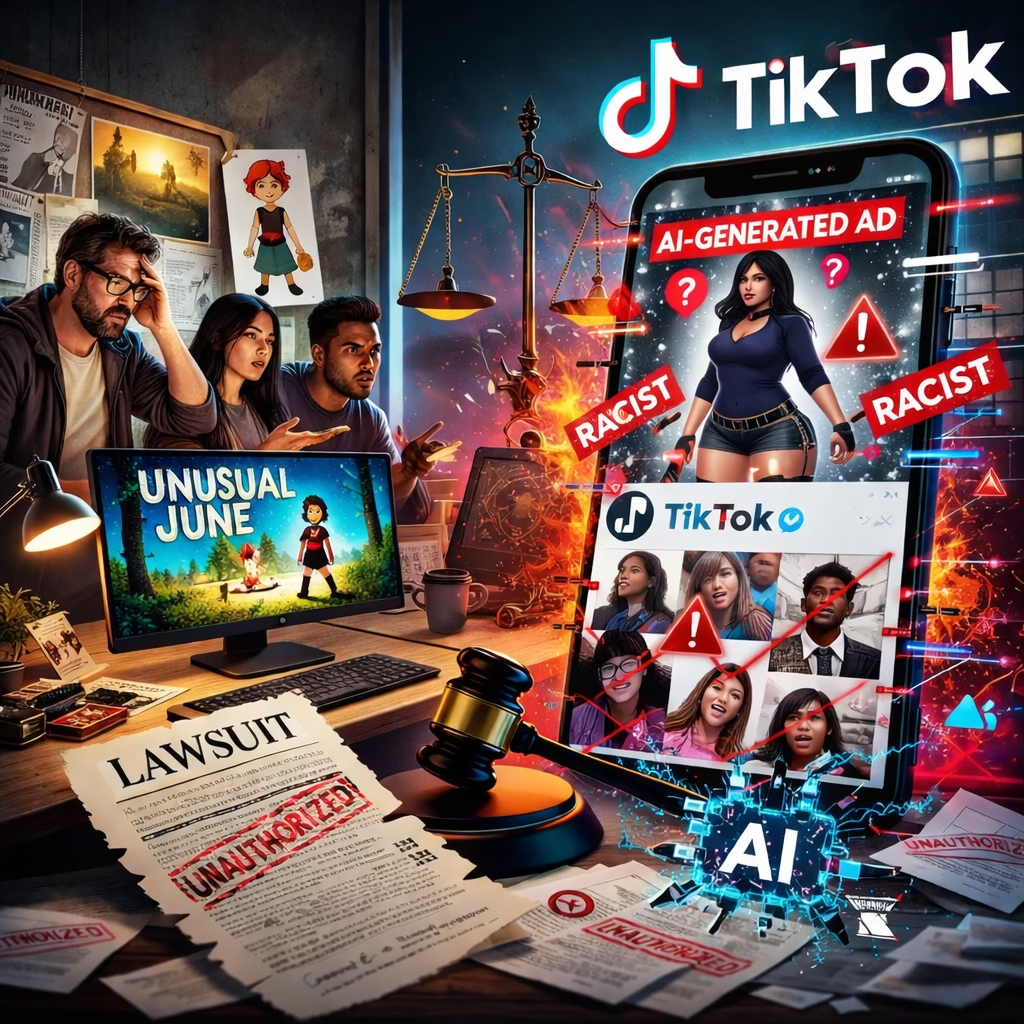

Indie game publisher and developer Finji, with popular titles such as Night in the Woods and Tunic, has alleged, on an extensive IGN report, that TikTok has been modifying its platform’s ads using generative AI (GenAI) without consent.1 Crucially, the ads are said to include “sexualised, racist, and sexist representation of [the] studio’s work“.2
Finji claims that the ads pushed by TikTok from Finji’s account included a “sexualised version of the game’s [Unusual June] female protagonist that differs substantially from her appearance in the game”.3 Specifically, IGN claims that one of the ads in question included an altered image of June, the female protagonist in question, “with a bikini bottom, impossibly large hips and thighs, and boots that rise up over her knees”.4 Finji’s CEO and co-founder, Rebekah Saltsman, described the ads as “invoking a racist, sexualised stereotype that bears no resemblance to the character’s actual design”.5
The ads came to Finji’s attention through comments on TikTok and its official Discord of users sharing screenshots and reporting the ads’ inappropriateness.6 The comments came as a surprise to Finji, and Saltsman quickly clarified that while Finji does run ads on TikTok, they had not opted into the platform’s AI tools, specifically TikTok’s ‘Smart Creative (a function that uses GenAI to create multiple versions of user-created ads), and ‘Automate Creative’ (a feature that uses AI to optimise assets such as images, music, and audio).7 Frustratingly to the studio, the ads were displayed as if they were posted from Finji’s verified TikTok account.8
To make matters worse, Finji explained that not only did they find out about the ads through their own users, but are also unable to edit or even view the AI-generated versions of its own ads.9 On February 6th, a TikTok support agent claimed there was no indication that GenAI was used, but Finji was able to provide evidence to disprove this claim, prompting the agent to acknowledge “the unauthorised use of AI, the sexualisation and misrepresentation of your characters, and the resulting commercial and reputational harm to your studio”.10
While TikTok promised that the matter would be immediately sent for further review, they had made no further contact thus far, and following another attempt by Finji to reach out, the platform merely said the ad campaign in question was using “a catalog ads format designed to demonstrate the performance benefits of combining carousel and video assets in sales campaigns”.11 According to TikTok, this catalog format did not have a guaranteed GenAI opt-out.12
Saltsman expressed her deep frustration with the situation, stating: “It’s one thing to have an algorithm that’s racist and sexist, and another thing to use AI to churn content of your paying business partners, and another thing to do it against their consent, and then to also NOT respond to any of those mistakes in a coherent way? Really?… For me—I am just super pissed off. This is my work, my team’s work and mine and my company’s reputation—which I have spent over a decade building… ”.13
Importantly, she continued by explaining her dissatisfaction with the use of GenAI: “My expectation was a proper apology, systemic changes in how they use this technology for paying clients and a hard look at why their technology is so obviously racist and sexist. I am obviously not holding my breath for any of the above”.14
Given the indie nature of the studio, this situation presents a real reputational risk to Finji, and thus, they have since ended the ad campaigns on TikTok, in an effort to stop the GenAI versions from appearing.15
The GenAI Crisis and Possible Implications
Tensions surrounding GenAI are already rising year by year, as the recent GDC 2026 State of the Game Industry Report demonstrated, with 52% of respondents saying they felt GenAI had a negative impact on the game industry, increasing from 18% of respondents in 2024 and 30% in 2025.16 This TikTok scandal will surely only serve as a fuel to the fire i.e. the scrutiny of how GenAI is employed in creative industries.17
This likely scrutiny has already started, only a few days after IGN published its report, with comments such as the following made by Kotaku’s Kenneth Shepard: “…given that genAI evangelists are scrambling to invent an actual use case for the technology to stop the slop accusations, it’s not too surprising that companies are shoving it into places without permission. It’s not like any company worth a damn is going to use this tech to “enhance” its ads when they’d rather those ads reflect what they’re actually selling”.18
This situation can be said to perfectly encapsulate the exact reason professionals in the gaming industry are so worried. Studios are particularly anxious, raising questions about the AI’s effect on consent, transparency, and control.19 In Finji’s situation, the lack of safeguards with the use of GenAI could prove disastrous, as the brand’s identity is key for their consumer retention.20
This controversy shows that if platforms can ‘hallucinate’ assets such as ads for games, publishers effectively lose the ability to properly manage their reputation amongst consumers. Studios like Finji rely on a specific and polished aesthetic in their games, and if unauthorised GenAI ads produce misleading content, that can devalue the perceived quality of a carefully curated game.
Furthermore, if TikTok acknowledged that Finji opted out of the use of AI, yet the ads still ran, and TikTok’s ‘explanation’ was that catalog ads did not have a guaranteed AI opt-out, it brings up several legal questions regarding consent. In addition, while AAA Studios have the legal teams to negotiate and defend themselves in such disputes, indie studios may not have the capacity to fight back, and thus any negative consequence arising from TikTok’s mistake could end up going unaddressed.
Takeaways and Suggestions
The Finji-TikTok dispute serves as a crucial moment for the gaming industry’s application of GenAI and the accountability of platforms. In order to ensure such a situation does not occur in the future, a couple suggestions are made by the author.
Firstly, the author believes that platforms need to be held liable when taking actions that may hurt the reputation of their users. To achieve this, the author suggests amending laws like Section 230 of the US Communications Decency Act, which was designed to protect platforms from the speech of their users (‘Safe Harbor’).
The proposed reform would be to include an amendment saying that if a platform generates content through its AI Tools, it should be classified as platform-authored content, and thereby it should lose its ‘Safe Harbor’ immunity and be held to the same defamation standards as any traditional publisher. With such an amendment, platforms will be more careful with how (and if) they use GenAI in their operations, and will ensure that any use of it is appropriate, accurate and protects their users’ reputation.
Another suggestion would be to mandate a mandatory consent framework for platforms when using GenAI i.e. platforms must ask for its users’ consent for the use of GenAI in operations relating to a user’s assets. If, as happened in the current controversy, a platform uses GenAI without consent, they should face strict liability and possibly even damages, allowing even small studios to be protected without a costly court battle.
It will be interesting to see how this dispute unfolds, however it surely serves as a glaring red flag on the increasing use of GenAI, the dangers that follow it, and the need to further regulate and monitor it.
- Wesley Yin-Poole, ‘Tunic, Night in the Woods Publisher Says TikTok Is Creating and Running Racist GenAI Ads for Its Games Without Permission’ (IGN, 20 February 2026) https://www.ign.com/articles/tunic-night-in-the-woods-publisher-says-tiktok-is-creating-and-running-racist-genai-ads-for-its-games-without-permission accessed 23 February 2026.
↩︎ - ibid.
↩︎ - Sophie McEvoy, ‘Night in the Woods publisher Finji accuses TikTok of creating “racist, sexist” and uneditable GenAI ads for its games’ (GamesIndustry.biz, 20 February 2026) https://www.gamesindustry.biz/night-in-the-woods-publisher-finji-accuses-tiktok-of-creating-racist-sexist-and-uneditable-genai-ads-for-its-games accessed 23 February 2026.
↩︎ - Kenneth Shepard, ‘Night In The Woods Publisher Confronts TikTok Over Racist AI Ads’ (Kotaku, 20 February 2026) https://kotaku.com/finji-tiktok-racist-genai-ads-usual-june-report-support-2000672007 accessed 24 February 2026.
↩︎ - Dimas Ibnu, ‘Finji Accuses TikTok Of Racist GenAI Ads For Night In The Woods, Usual June’ (Shane the Gamer, 20 February 2026) https://www.shanethegamer.com/esports-news/finji-tiktok-racist-genai-ads/ accessed 24 February 2026.
↩︎ - Sophie McEvoy, (n 3).
↩︎ - Wesley Yin-Poole, (n 1).
↩︎ - Dimas Ibnu, (n 5).
↩︎ - Sophie McEvoy, (n 3).
↩︎ - Sophie McEvoy, (n 3).
↩︎ - Sophie McEvoy, (n 3).
↩︎ - Kenneth Shepard, (n 4).
↩︎ - Wesley Yin-Poole, (n 1).
↩︎ - Wesley Yin-Poole, (n 1).
↩︎ - Dimas Ibnu, (n 5).
↩︎ - GDC survey reveals layoffs up 6%, 36% of industry using AI, and overwhelming support for unionisation in the US, GamesIndustry.biz (website post, 2026) https://bit.ly/4rmq1K6 accessed 23 February 2026.
↩︎ - Dimas Ibnu, (n 5).
↩︎ - Kenneth Shepard, (n 4).
↩︎ - Dimas Ibnu, (n 5).
↩︎ - Dimas Ibnu, (n 5).
↩︎