General
Unity, Tencent, and the New Digital Borders: How Geopolitics is Changing Gaming in 2026

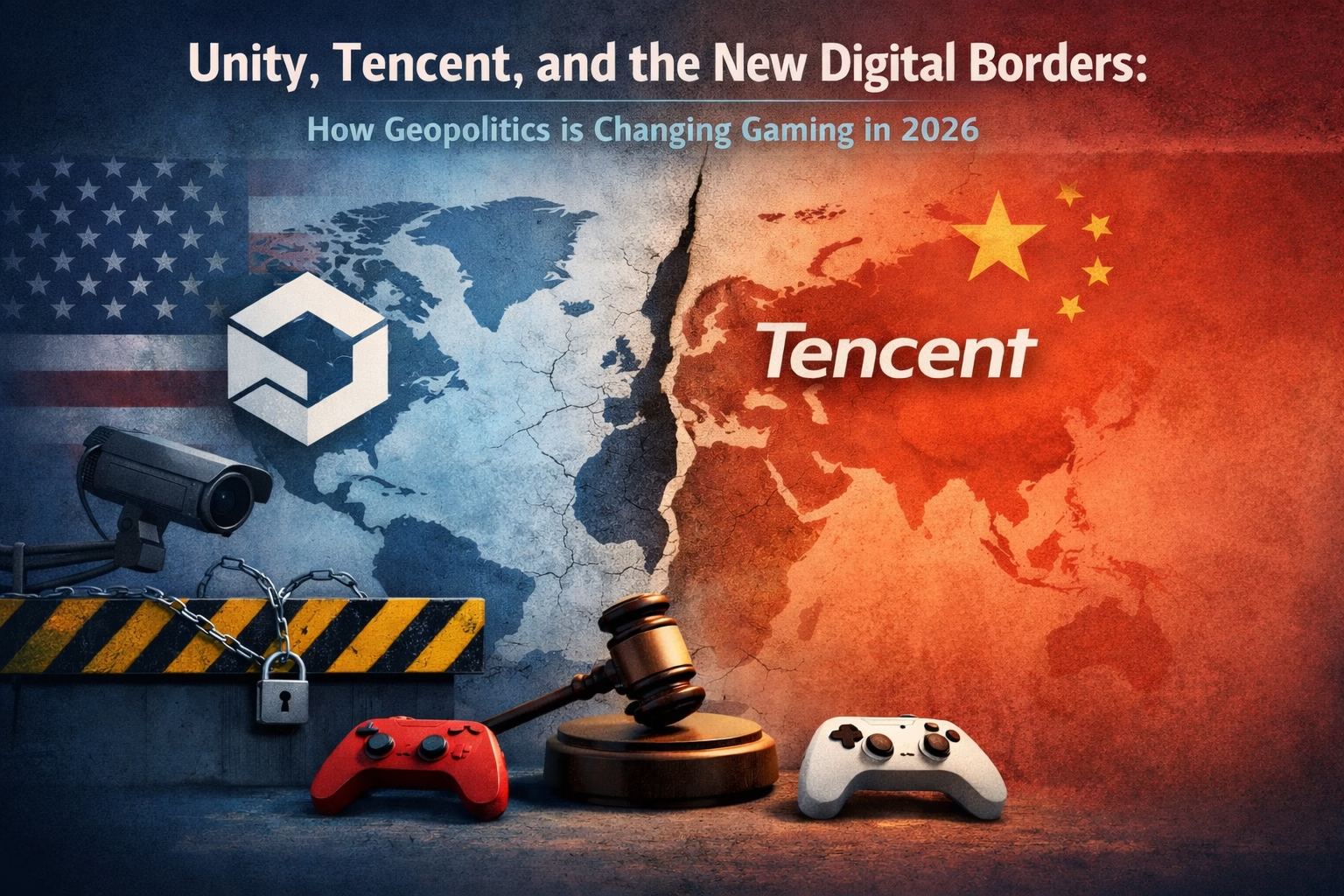

Table of Contents
Unity, the creator of the Unity Game Engine, a popular platform for creating video games, powering games like Among Us, has announced on a forum post the delisting of assets from publishers based in China, Hong Kong, and Macau from its Unity Asset Store.1 The spokesperson on the forum cited updated regional licensing, distribution, and compliance requirements for publishers in the Greater China region as the reason for the delisting.2
Furthermore, the change also seems to be related to a separate Chinese asset store that was established for Tuanjie Engine, which is a localised version of Unity in China.3 With the delisting, it seems Unity has decided to permanently separate the two asset stores.4
Organisations based in Greater China will therefore no longer be able to use the Global Unity Asset Store and will have to download all their assets before March 31st, 2026 (the official delisting date), in order to retain ownership.5
For Unity users who have purchased assets from publishers in Greater China, the delisting means they will no longer enjoy updates or support for those assets.6 Moreover, assets purchased within the past six months are refundable.7
Thus far, Unity users do not seem to be pleased with the news, with many negative reviews appearing on the Unity forum questioning the decision. The main criticism that consistently appears is the fact that Unity has published a list of impacted assets that users need to check in order to determine whether they need to take action,8 which users have described as “less than helpful”.9 Moreover, many users raised concerns about growing global divides.10
The delisting comes approximately one year after Unity 6 was also taken out of the Greater China region, which left developers in that area with their own customised version of the engine.11 The Unity 6 decision, according to Unity, came due to a “long-term plan that led to the creation of a China joint venture in 2022…”,12 rejecting the speculations that it was in response to heavy tariffs imposed on China by the Trump administration.
Nevertheless, recent events on top of the Unity delisting news seem to demonstrate that geopolitics are coming into play more and more in the gaming industry. Specifically, there are currently growing discussions amongst the US government to compel Chinese giant Tencent to divest its ownership in game companies, as was revealed in a Financial Times report.13
Tencent’s ownerships are made up of a 28% stake in Epic Games, and a 100% stake of Riot and Turtle Rock, along with minority stakes in companies such as Ubisoft.14 Given the company’s portfolio, an investigation by the Committee on Foreign Investment in the United States (CFIUS), which was launched by the Biden administration, raised concerns over Tencent’s access to the personal data of millions of American players.15
Many Biden-era officials claimed that Tencent’s gaming investments give it access to a “significant intelligence collection source”, arguing that CFIUS should force the firm to divest its investments.16 However, the US Treasury decided to handle the issue by creating data protections instead.17 Furthermore, Tencent was added to a Pentagon blacklist of companies with connections to the Chinese military, however the company has repeatedly denied any such sort of affiliation.18
With the current Trump administration, which has already made demands of corporations with Chinese ownership, for example compelling TikTok to divest its US operations, the Tencent issue is back under White House scrutiny and stringent steps are expected to be taken.19 A meeting was scheduled between cabinet officials and president Donald Trump ahead of his meeting with Xi Jinping, however the meeting was postponed due to scheduling conflicts.20
The Weight of Geopolitical Turmoil
Video games lawyer Peter Lewin reacted to the Unity and Tencent’s situations on a Linkedin post, stating: “The games industry wasn’t immune to geopolitical turmoil before. But now we’re starting to see some real, tangible impacts”.21
Firstly, as Lewin explains, tariffs and component shortages are driving up prices, which is not only passed on to consumers through costs of games, consoles, etc., but also leads (indirectly) to the delay of new hardware releases, such as the Steam Machine, which has been delayed due to PC hardware shortages causing a spike in price.22
Secondly, we are now seeing increased division, with more territories legally requiring local distributors. South Korea, for example, now requires, through the Game Industry Promotion Act, foreign game companies operating in Korea to designate a local representative.23 This could create a significant barrier to entry for indie developers, who may wish to operate in Korea, but are unable to financially sustain the administrative costs of maintaining a local representative. This signals that the global digital publishing market is being replaced by numerous regional markets, making it more difficult for all types of developers to break into the competitive video game scene.
Lastly, we are actively witnessing increasing amounts of divestments from Western gaming companies. ByteDance (who also owns, and was compelled to divest, TikTok) is set to sell its entire games division Montoon to Saudi Arabia’s Savvy Games Group (who have been actively expanding in the gaming market).24 NetEase is another example, as the corporation has already divested from six of its western studios.25
Therefore, as explained by Peter Lewin, we are increasingly seeing a reality in the gaming industry where software availability is being limited by the physical borders of the developer.26
Lewin also does not sound particularly optimistic about the future, explaining that “With changes like these, it’s not hard to imagine the US beginning to impose blocks / approvals / tariffs on foreign games (see last year’s threat of 100% tariffs on non-US made films). After all, if there’s a security concern with US-based companies being backed by external investors, why are externally made games any different”.27
While Lewin focuses on the U.S. regulatory landscape in his statement, his warning reflects a broader, systemic shift toward ‘Digital Protectionism’ worldwide. As demonstrated, we are already seeing this play out in South Korea. It is likely that as digital borders get stricter, other jurisdictions in Europe and elsewhere will follow suit, moving away from the borderless status quo.
Takeaways
Unity’s delisting and the potential divestment of Tencent marks a paradigm shift for the gaming industry. Seemingly, we are moving away from an era of borderless digital commerce and toward an era shaped by digital borders and ‘sovereignty’, where a developer’s physical jurisdiction is critical.
As discussed above, we can also expect the cost of global operations within the gaming industry to inevitably rise. As hardware prices increase and operations become less efficient, consumers are likely to see both price hikes as well as delays in the games and consoles they are looking forward to.
In that vein, developers should prepare for a more complex game development process, where both Western regulations, and potentially Chinese regional requirements, for example, will need to be satisfied. Developers will likely also need to implement methods to track the ‘geopolitical origin’ of their software components, to ensure full compliance. Moreover, as the Tencent situation demonstrates, developers must start prioritising transparent data collection practices in order to avoid the scrutiny of organisations like CFIUS.
Therefore, the Unity and Tencent situations signal a future where a game or console’s success might depend less on its quality, and more on its ability to navigate a series of regional hurdles, such as tariffs, data protection requirements, and mandatory local partnerships. Thus, the gaming industry must be ready to adapt to this new era of protectionism, as otherwise, it risks a future where beloved games, like Among Us, are restricted by the borders of its developers.
- Chris Kerr, ‘The Unity Asset Store is ditching publishers based in China, Hong Kong, and Macau’ (Game Developer, 3 March 2026) https://www.gamedeveloper.com/production/the-unity-asset-store-is-ditching-publishers-based-in-china-hong-kong-and-macau accessed 8 March 2026.
↩︎ - ibid.
↩︎ - Amber Rutherford, ‘Unity Asset Store To Remove Assets From Greater China Publishers’ (80 Level, 4 March 2026) https://80.lv/articles/unity-asset-store-to-remove-assets-from-greater-china-publishers accessed 8 March 2026.
↩︎ - ‘Assets from Chinese developers will be removed from the Unity Asset Store’ (Game World Observer, 3 March 2026) https://gameworldobserver.com/2026/03/03/assets-from-chinese-developers-will-be-removed-from-the-unity-asset-store accessed 8 March 2026.
↩︎ - Chris Kerr, (n 1).
↩︎ - Chris Kerr, (n 1).
↩︎ - Chris Kerr, (n 1).
↩︎ - Amber Rutherford, (n 3).
↩︎ - Chris Kerr, (n 1).
↩︎ - Amber Rutherford, (n 3).
↩︎ - Chris Kerr, (n 1).
↩︎ - Bryant Francis, ‘Removal of Unity 6 from China “not tied” to tariffs, says Unity’ (Game Developer, 17 April 2025) https://www.gamedeveloper.com/business/removal-of-unity-6-from-china-not-tied-to-tariffs-says-unity accessed 8 March 2026.
↩︎ - Jon Hicks, ‘Report: US government may compel Tencent to divest gaming investments’ (GamesIndustry.biz, 4 March 2026) https://www.gamesindustry.biz/report-us-government-may-compel-tencent-to-divest-gaming-investments accessed 8 March 2026.
↩︎ - ibid.
↩︎ - ibid.
↩︎ - ibid.
↩︎ - ibid.
↩︎ - ibid.
↩︎ - ibid.
↩︎ - Andy Chalk, ‘US government reportedly debating whether to force Tencent to give up its US-based game holdings’ (PC Gamer, 6 March 2026) https://www.pcgamer.com/gaming-industry/us-government-reportedly-debating-whether-to-force-tencent-to-give-up-its-us-based-game-holdings/ accessed 8 March 2026.
↩︎ - Peter Lewin, ‘Unity is removing all Unity Asset Store assets from publishers in China’ (LinkedIn, 3 March 2026) https://www.linkedin.com/posts/peter-lewin_unity-is-removing-all-unity-asset-store-assets-activity-7435677018811334656-B2ZW accessed 8 March 2026.
↩︎ - Michael Higham and Wesley Yin-Poole, ‘Valve Stands Firm the Steam Machine Will Launch In 2026 Despite Delays, “Memory and Storage Shortages” Still Challenging [UPDATED]’ (IGN, 6 March 2026) https://www.ign.com/articles/valve-stands-firm-the-steam-machine-will-launch-in-2026-memory-and-storage-shortages-still-challenging-updated accessed 8 March 2026.
↩︎ - Ariel SG Weiner, Ellen T Berge and Melissa Steinman, ‘South Korea Imposes New Regulations on Loot Boxes and Other Randomized In-Game Items’ (Lexology, 18 October 2024) https://www.lexology.com/library/detail.aspx?g=f9d1e085-c3e8-4199-b328-ae923a7c4f03 accessed 8 March 2026.
↩︎ - Josh Ye and Kane Wu, ‘ByteDance in talks to sell gaming unit Moonton for more than $6 billion, sources say’ (Reuters, 13 February 2026) https://www.reuters.com/world/asia-pacific/bytedance-talks-sell-gaming-unit-moonton-more-than-6-billion-sources-say-2026-02-13/ accessed 8 March 2026.
↩︎ - Andy Chalk, ‘NetEase breaks up with another Western studio, but it “refuses to die” and instead remains “motivated and deeply committed to the incredible game we’re building”’ (PC Gamer, 19 February 2026) https://www.pcgamer.com/gaming-industry/netease-breaks-up-with-another-western-studio-but-it-refuses-to-die-and-instead-remains-motivated-and-deeply-committed-to-the-incredible-game-were-building/ accessed 8 March 2026.
↩︎ - Peter Lewin, (n 21).
↩︎ - Peter Lewin, (n 21).
↩︎